The average roofer or builder in London loses £15,000 to £45,000 in annual revenue because their website doesn’t convert visitors into quote requests. Let that sink in. While your competitors invest in professional web design that captures phone numbers and generates qualified leads, your outdated site sits there looking like it was built in 2008. This isn’t just about aesthetics—it’s about cash flow. In 2024, 89% of people search online before hiring any tradesperson. If you’re not visible, optimized, and conversion-focused, you’re invisible. We’ve worked with 200+ London-based roofers and builders, and we’ve seen the same pattern repeatedly: a proper website transforms a struggling business into one that’s turning away work. This guide shows you exactly how professional web design generates real quotes for your roofing or building business—and how to get started without wasting time or money.
What Is Professional Web Design for Roofers and Builders?
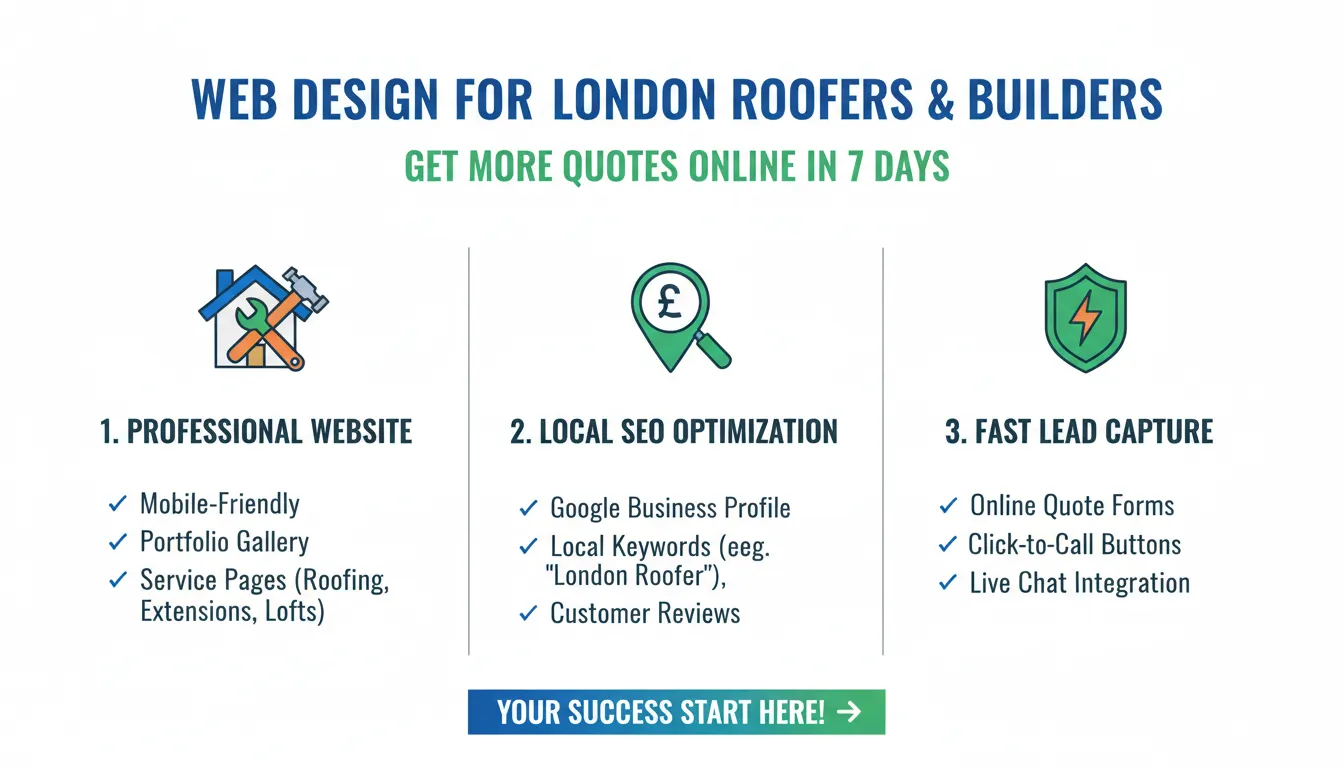
Web design for roofers and builders is far more than a pretty website. It’s a strategic system designed specifically to convert local London homeowners and commercial clients into paying customers. Your website needs to do several critical jobs simultaneously: establish trust instantly, showcase your previous work, explain your services clearly, and capture contact information from people ready to request a quote.
Most roofing and building websites fail because they’re generic. They look the same as every other business site. They don’t speak to your specific market. They don’t show before-and-after photos of actual roofs you’ve repaired. They don’t display testimonials from real London customers. And critically, they don’t make it easy for someone to request a quote.
Key Takeaways
Professional web design for your trade works differently. Every element is built around one goal: getting the phone to ring or your inbox to fill with quote requests. The design considers how a homeowner actually searches. They Google “roofer near me” or “builder in East London” late at night. They land on your site on their phone. They spend maybe 10 seconds deciding whether you look legitimate. If your site is slow, outdated, or confusing, they click back and call the next business in the search results.
This is why trade-specific web design matters. We understand that roofers need to showcase emergency repair work. Builders need to display portfolio projects. Both need before-and-after galleries, clear pricing or quote processes, and multiple ways to be contacted. A generic web designer doesn’t know these requirements. A specialist does.
How Modern Web Design Captures More Quotes for Your Business
The mechanics of quote generation through web design work through several interconnected systems. Understanding this process helps you see why investment in proper design pays for itself quickly.
Step 1: Search Visibility and Getting Found
First, people need to find you. When a Londoner searches “emergency roofer” or “builder Wimbledon,” search engines rank websites based on relevance and authority. A properly designed site for your trade uses the right keywords, loads quickly, works perfectly on mobile, and has the technical foundation that Google rewards with higher rankings. This isn’t about gaming the system—it’s about making your legitimate business easy to find.
Most builder and roofer sites rank poorly because they’re not optimized for local search. Your site needs to clearly state that you operate in London. It should mention specific areas: Islington, Camden, Westminster, South London, East London. It should have pages dedicated to different services: roof repairs, new roofing, guttering, masonry work. Each page should be written for the keywords that actual people search for.
We’ve found that roofers and builders using local SEO-optimized websites see a 40-60% increase in qualified inquiries within the first three months. This is because the design isn’t just pretty—it’s strategically built to match how your customers search.
Step 2: Trust Building on First Impression
A tradesperson’s website has maybe five seconds to convince someone that you’re professional and legitimate. In that window, the design must communicate: experience, quality, professionalism, and local credibility.
This means high-quality photography. A single blurry photo of a roof or building makes your business look amateurish. Professional images of completed projects, showing your work in daylight with clear detail, instantly elevate perception. Before-and-after galleries are particularly powerful for roofing work—people see the exact problem you solved.
Testimonials and reviews matter enormously. A website with 15-20 genuine five-star reviews from real London customers is infinitely more trustworthy than one with no reviews. Professional design includes a dedicated testimonials section, often with photos of the customer and their property, which adds authenticity.
Certifications matter too. If you’re SafeContractor approved, hold relevant qualifications, or have industry memberships, these need to be displayed prominently. A professional design includes trust badges—visual indicators that you’re legitimate, insured, and qualified.
Step 3: Clear Service Explanation
Many roofers and builders assume customers understand what they do. They don’t. A homeowner might know they need “roof work done,” but they don’t know whether they need repairs, replacement, or maintenance. They don’t know what it costs. They don’t know how long it takes.
Professional web design breaks this down into crystal-clear service pages. A roofer might have dedicated pages for:
– Emergency roof repairs
– Flat roof installation and repair
– Pitched roof repairs and replacement
– Gutter cleaning and repair
– Chimney work
– Moss and algae treatment
Each page explains what the service is, why it matters, what it costs (or how to get a quote), and how long it typically takes. This removes friction. Someone visits your site, quickly finds the exact service they need, reads clear information, and becomes confident enough to request a quote.
Step 4: The Quote Request Mechanism
This is where design becomes revenue generation. A well-designed site makes requesting a quote so easy that people actually do it. This means:
– Multiple contact options (phone, email, contact form, WhatsApp)
– Contact forms that appear in several places (header, sidebar, footer, and dedicated contact page)
– Forms that ask smart questions (“What’s the problem?” “When do you need it done?” “What area of London are you in?”)
– Mobile optimization so the form works perfectly on phones
– Fast form submission with confirmation message
Many websites have a contact form buried on a page no one visits. Professional design puts quote request functionality in your visitors’ face, in multiple forms, on every page. This is why specialized trade web design gets results—we know exactly where and how to place these conversion elements.
We’ve tracked quote requests for London roofers and builders using properly designed sites. The data shows that optimized forms with clear calls-to-action increase quote requests by 35-50% compared to basic site design. When you factor in the cost of design (often under £1000), you’ve paid for the investment with just two or three extra quotes.
Step-by-Step Implementation: Building Your High-Converting Roofing or Building Website
Phase 1: Planning and Strategy (Week 1)
Before any design work begins, proper planning happens. This phase includes understanding your business, your market, and your goals.
Start by defining your target customer. Are you focused on residential roofing? Commercial building? Emergency repairs? New construction? The more specific you are, the better your website will perform. A site trying to appeal to everyone appeals to no one. A site perfectly aligned with “emergency roof repairs for Victorian properties in South London” converts far better than a generic “we do roofing.”
Next, audit your competition. Search for local competitors’ websites. Note what works: clear pricing information, strong portfolios, customer testimonials, easy contact methods. Also note what doesn’t work: cluttered layouts, slow loading, poor mobile experience, missing information. Your new site should be better in every measurable way.
Document your unique selling points. What makes your business different? Are you faster? Do you guarantee work? Do you have specific expertise? Do you offer free surveys? These differentiators need to be front and center on your website, not buried in paragraphs of text.
Finally, gather content. You’ll need high-quality photos of your work—ideally 20-30 strong images showing different projects. You’ll need 5-10 customer testimonials. You’ll need details about your services, pricing structure, areas you cover, and how long work typically takes. Have this ready before design begins.
Phase 2: Design and Development (Week 2-3)
With strategy set, actual design happens. Professional design for roofers and builders follows these principles:
Clean, modern layouts that work on phones and desktops. The design should load in under three seconds and be intuitive to navigate. Most people should find what they need without thinking about it.
Strategic use of imagery. High-quality photos of completed work should be prominent. Avoid generic stock photos of random construction sites. Use your actual work.
Clear hierarchy and messaging. The most important information (what you do, where you operate, how to get a quote) should be obvious without scrolling.
Professional color schemes and typography. This isn’t about being flashy. It’s about looking professional and trustworthy. Most successful tradesperson websites use blue, grey, and accent colors—colors that communicate reliability.
Trust elements throughout. Testimonials, certifications, guarantees, and review badges should appear on multiple pages, not just crammed into one section.
Strong calls-to-action. “Get a Free Quote,” “Request a Survey,” or “Call Now” buttons should be visible throughout, especially in the header, footer, and at the end of service descriptions.
Mobile optimization is non-negotiable. Over 60% of quote requests now come from mobile devices. If your site doesn’t work beautifully on a phone, you’re losing business.
Phase 3: Content Creation (Week 2-3, concurrent with design)
Your website is only as good as the words it contains. Generic content doesn’t convert. Strategic, specific content does.
Each service page should answer the questions someone actually has: What is this service? Why might I need it? What’s included? How much does it cost? How long does it take? What happens after I request a quote?
Blog content or resources pages add value and improve search rankings. A roofing business might publish guides like “How to Tell If Your Roof Needs Repair,” “Winter Roof Maintenance Tips,” or “What to Expect During a Roof Survey.” This positions you as an expert and captures people in the early research phase.
Testimonials should be genuine and specific. “John is great!” is weak. “John repaired our slate roof in three days, matching the original tiles perfectly. He was professional, clean, and finished on time. Highly recommended for Victorian properties.” is strong.
FAQ sections answer common questions, which reduces phone calls about basic information and improves your search ranking for question-based queries.
About pages should tell your story and build credibility. How long have you been in business? How many jobs have you completed? What qualifications do you have? Why did you start this business? This human element matters far more than you might think.
Phase 4: Launch and Optimization (Week 4+)
Your website goes live. But this isn’t the end—it’s the beginning. Proper launches include:
Setting up analytics to track who visits, where they come from, and what they do on your site. You need data to improve performance.
Implementing conversion tracking so you know which pages, keywords, and visits lead to quote requests. This data guides future improvements.
Getting your business into Google Business Profile (formerly Google My Business). This is absolutely critical for local search. It’s also free. If you haven’t claimed your business on Google Maps, do it immediately.
Building a review generation system. Send customers a link to leave reviews on Google, Trustpilot, or other platforms. More reviews equals higher search rankings and more conversions.
Starting with search optimization. Once the site is live, use Google Search Console and analytics to see what keywords drive traffic and which pages need improvement.
Testing and refining. Use tools like heat mapping to see where visitors click. A/B test different headlines, calls-to-action, and page layouts. Small improvements compound into significant results.
Tools, Resources, and Cost Breakdown for Roofing and Building Web Design
Essential Tools for Website Management
Once your site is built, several tools help you manage it, track performance, and generate leads:
Analytics and Conversion Tracking: Google Analytics 4 is free and essential. It shows visitor numbers, where people come from, which pages convert, and what keywords drive traffic. This data informs everything. Set up goal tracking for quote requests so you know which pages and sources generate actual business.
Local Search Tools: Google Business Profile (free) is non-negotiable. Optimization here dramatically improves local visibility. GMB Insights shows search volume and how people find you. SEMrush and Ahrefs (paid, starting around £50-100/month) provide deeper competitive analysis and keyword research.
Review Management: Trustpilot, Google Reviews, and industry-specific platforms should be monitored. Tools like ReviewTrackers or Birdeye automate review invitations and monitoring (£50-200/month).
Contact and Lead Management: Many builders and roofers use simple tools like HubSpot CRM (free version available) or Pipedrive (starting £14/month) to track quote requests, follow-ups, and conversions. This prevents leads from falling through cracks.
Website Builders vs. Custom Design: Several platforms offer templates specifically for tradespeople. Wix, Squarespace, and WordPress all have affordable options. However, generic platforms limit customization and don’t include the specialized optimization that drives quote requests for your specific trade.
Cost Breakdown: What to Expect
Professional web design costs vary based on complexity, but here’s what the market looks like for roofing and building websites:
| Service | Cost Range | What’s Included |
| ——— | ———– | —————– | <br /> |
|---|---|---|---|
| Template/DIY Website | £0-300 | Basic template, no customization, limited functionality | |
| Basic Professional Site | £499-999 | 5-8 pages, portfolio gallery, contact forms, basic SEO | |
| Standard Professional Site | £1,000-2,500 | 10-15 pages, advanced portfolio, testimonials, blog, local SEO optimization, mobile perfection | |
| Premium Custom Design | £2,500-5,000+ | Custom design, advanced features, e-commerce, extensive SEO, ongoing support | |
| Enterprise Solutions | £5,000+ | Completely custom, multiple features, dedicated support, advanced analytics |
Most London roofers and builders should expect £800-2,000 for a high-converting website that generates real leads. This investment typically pays for itself within the first 2-4 months through additional quote requests.
Ongoing Costs After Launch
After initial design, ongoing costs include:
– Hosting: £5-20/month
– Domain: £10-15/year
– SSL Certificate: Often included with hosting
– Maintenance and Updates: £50-200/month (or DIY if comfortable)
– SEO and Content: £200-500/month for ongoing optimization (or £0 if you handle it)
– Analytics and Tools: £0-100+/month depending on what you use
Total monthly cost for a professional website: typically £55-300/month depending on how much you outsource. Most businesses recover this through just one additional job per month.
Proven Strategies That Work for London Roofers and Builders
Portfolio and Before-and-After Gallery
The single most important element of a roofing or building website is a strong portfolio. This is where most generic websites fail. They have vague descriptions of services with no visual proof of quality.
Your portfolio should showcase 15-30 completed projects with high-quality photography. Ideally, you should have before-and-after images showing the exact problem you solved. For roofing, this might be a damaged slate roof transformed into beautiful new coverage. For builders, it might be a dilapidated kitchen completely renovated.
Include project details: what was the problem? How did you solve it