Introduction: Why Plumbers in London Need a Website Now
Here’s a sobering statistic: 78% of homeowners search online before calling a plumber, yet only 45% of London plumbers have a professional website. If you’re not online, you’re invisible to customers in the middle of a burst pipe emergency. And worse? Your competitors are capturing those leads.
The plumbing industry in London is competitive. Emergency work, boiler maintenance, central heating repairs—these are high-value jobs worth thousands of pounds annually per customer. But you’ll never win that work if your website looks outdated, loads slowly on mobile, or—worse still—doesn’t exist at all.
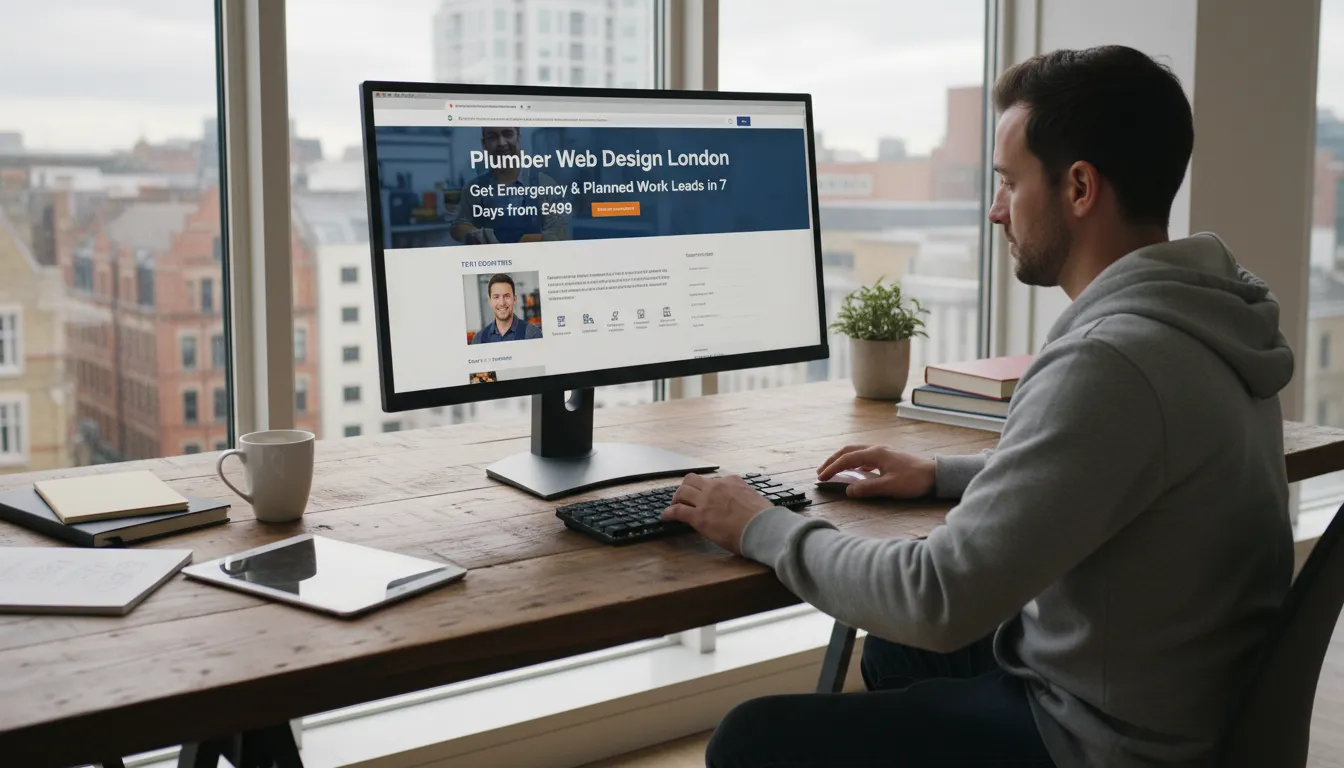
This isn’t about vanity. A proper plumber website does three critical things: it builds trust, it captures emergency leads 24/7, and it handles your booking requests automatically. When someone’s boiler fails at midnight, they’re not calling a plumber they’ve never heard of. They’re calling the one with the professional website that shows up first on Google, displays customer reviews, and makes it dead simple to book an emergency visit.
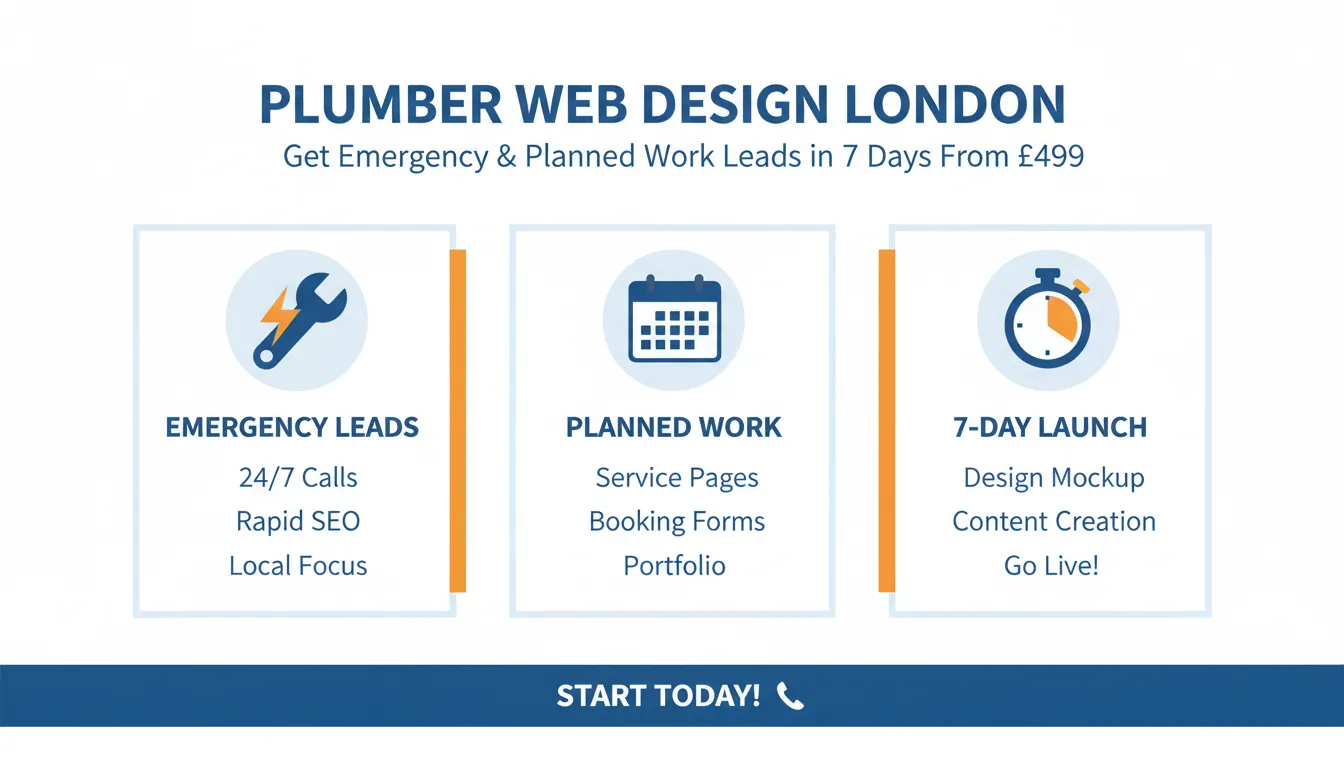
The good news? You don’t need to spend thousands of pounds or wait months. A professional plumber website can be live in just 7 days, starting from £499. This guide walks you through exactly what you need, why it matters, and how to get it right the first time.
Key Takeaways
—
Key Takeaways
What a Professional Plumber Website Actually Is
A plumber website isn’t just a digital business card. It’s a 24/7 sales and customer service machine that works while you’re out fixing pipes.
A proper plumber website has these core elements:
1. Mobile-First Design
Over 70% of plumbing-related searches now happen on mobile phones. Someone’s boiler just failed at 9 PM. They’re searching on their phone in a panic. Your website must load instantly on mobile and be easy to navigate with thumbs. Slow sites lose customers to competitors in seconds.
2. Emergency Lead Capture
Your site needs prominent call buttons, contact forms, and booking systems. These should be visible above the fold (before users scroll). A simple “Request Emergency Visit” button can capture dozens of leads monthly that would otherwise go to competitors.
3. Trust Signals & Social Proof
Customer reviews, certifications (Gas Safe, CIPHE, etc.), photos of completed work, and testimonials build credibility. People want to see proof you’re legitimate and trusted. Displaying these prominently converts browsers into callers.
4. Local SEO Optimization
Your website should be optimized for local searches like “emergency plumber Clapham” or “heating engineer Wandsworth.” This means proper location pages, schema markup, and locally-relevant content. Without this, you won’t appear in Google’s local 3-pack—the three business listings that appear at the top of local searches.
5. Service Pages & Descriptions
Dedicated pages for emergency plumbing, boiler repairs, central heating, bathroom installations, and planned maintenance. Each page should clearly explain what you do, why you’re qualified, and why someone should call you instead of a competitor. This helps both customers and Google understand your business.
6. Fast, Reliable Hosting
Your website needs to load in under 3 seconds. Every second of delay increases bounce rates by up to 7%. Poor hosting wastes your marketing efforts.
A website isn’t just text and images. It’s a complete system designed to turn online searchers into paying customers—while you sleep.
—
Step 1: Understanding Your Plumber Website Requirements
Before you buy anything or talk to a designer, understand what you actually need. Too many plumbers either build websites that are too basic (missing essential features) or overly complex (with bells and whistles that waste money).
Your First Decision: What Type of Plumber Are You?
This matters because it shapes your website strategy:
– Emergency-Only Plumbers: Your website must emphasize 24/7 availability. You need booking forms that work at midnight. Your testimonials should highlight speed of response.
– Heating Engineers: Your site needs detailed explanations of boiler services, maintenance plans, and why regular servicing saves money. You’ll want before/after galleries and certification badges prominently displayed.
– General/Mixed Services: You do emergency work, planned maintenance, and installations. Your site needs clear navigation to help customers find exactly what they need quickly.
Essential Pages Every London Plumber Needs
1. Home Page (Your first impression)
– Clear headline stating what you do and your service area
– Prominent call and contact buttons
– 3-5 customer reviews or testimonials
– Your key differentiator (e.g., “Gas Safe Registered,” “Available 24/7,” “Fixed Price Quotes”)
– Call to action (usually “Book Emergency Visit” or “Request a Quote”)
2. Emergency Plumbing Page
– What’s considered an emergency
– Your response time
– Your call-out charge (if any) and what’s included
– Booking form or phone number
– Testimonials from emergency jobs
3. Services Pages (One for each major service)
– Boiler repairs and servicing
– Central heating maintenance
– Bathroom installations
– Pipe repairs and leaks
– Drain cleaning and unblocking
– Each page should explain the problem, your solution, and why it matters
4. About Us Page
– Your story (keep it brief and genuine)
– Team photos (builds trust)
– Certifications and accreditations
– Years in business and customer numbers served
– Why customers should choose you
5. Gallery/Portfolio Page
– Photos of completed work (boiler installations, bathroom refits, etc.)
– Before/after images where possible
– Captions explaining the project
6. Service Areas Page
– List all London postcodes you cover
– Brief explanation of your coverage area
– Links to specific neighborhood pages (especially if you serve multiple areas like Clapham, Wandsworth, Stoke Newington, Peckham, Finsbury Park, etc.)
7. Contact/Booking Page
– Clear contact form
– Phone number (clickable on mobile)
– Address (if customers visit you)
– Booking system or calendar (optional but recommended)
– Hours of operation
8. Testimonials/Reviews Page (Optional but powerful)
– Aggregated customer feedback
– Star ratings
– Videos if possible
What You Should NOT Include
– Outdated photos (customers can tell if images are 5+ years old)
– Vague pricing (“Call for a quote” loses people—be specific)
– Slow-loading multimedia that serves no purpose
– Complex navigation (customers should find what they need in 2 clicks)
– Anything that requires Flash or obsolete technology
– Pages that aren’t useful (like “Our Team” pages with no photos, or “Blog” sections that haven’t been updated in two years)
—
Step 2: Building Your Website—The 7-Day Timeline
Professional plumber websites don’t need to take months. Here’s how to launch in 7 days without sacrificing quality:
Day 1-2: Planning & Content Preparation (4-6 hours)
Before any design happens, gather your assets:
– Logo (if you have one; if not, we can create a simple one)
– High-quality photos of you, your team, completed work, and your van/truck
– List of services with brief descriptions
– Certifications & accreditations (Gas Safe number, CIPHE, etc.)
– 5-10 customer testimonials (ask recent customers for written feedback or offer a small discount for video testimonials)
– Service area postcodes (all the areas you cover)
– Pricing information (at least ranges for common services)
Don’t have great photos? This is critical. Professional photography of plumbing work isn’t expensive. A half-day photo shoot of a boiler installation, a pipe repair, and team shots costs £300-500 but dramatically increases trust and conversion rates.
Day 2-3: Website Design & Setup (6-8 hours)
A fast-track designer will:
– Create a mobile-responsive design based on a proven plumber website template
– Set up your hosting and domain
– Build the 8 essential pages listed above
– Install Google analytics and Google Business Profile integration
– Set up SSL certificate (security—essential for any website in 2025)
– Configure contact forms and basic lead tracking
This isn’t custom hand-coding for a fashion brand. It’s a professional, clean design that follows proven conversion principles for service businesses. Most plumbers don’t need a bespoke design; they need something that works and builds trust.
Day 3-4: Content Writing & SEO Setup (4-6 hours)
This is where most DIY websites fail. You need:
– Home page copy that immediately tells visitors what you do and why they should call you
– Service page descriptions that answer customer questions and include local keywords (e.g., “Emergency boiler repair in Wandsworth”)
– Local SEO setup: Google Business Profile optimization, location schema markup, local keyword integration
A professional copywriter familiar with plumbing will write this to convert visitors into callers. Every sentence serves a purpose.
Day 4-5: Photos, Forms & Integration (4-6 hours)
– Professional photos uploaded and optimized
– Contact forms tested and configured
– Booking system setup (if using)
– Phone tracking numbers installed (so you can measure which customers came from your website)
– CRM or email integration for lead notifications
Day 5-6: Testing & Optimization (3-4 hours)
Before launch:
– Mobile testing on all devices
– Page speed testing and optimization
– Form testing from multiple browsers
– SEO audit
– Spelling/grammar/accuracy check
Day 7: Launch & Monitoring
– Site goes live
– Google Business Profile submission
– Analytics setup verification
– You’re monitoring performance and receiving leads
This timeline isn’t fantasy. It works because it follows a proven process without unnecessary complexity. The difference between a 7-day launch and a 3-month project is usually unnecessary revisions, unclear requirements, and over-engineering.
—
Step 3: Optimizing for Local Search & Emergency Leads
Your website’s main purpose is simple: generate leads from people searching for plumbers in your area right now.
The majority of plumber searches are highly local and urgent. Someone in Clapham with a burst pipe isn’t calling a plumber in Peckham. They’re calling whoever appears first when they Google “emergency plumber near me” or “burst pipe repair Clapham.”
Local SEO Strategy for Plumbers
1. Google Business Profile (Critical)
– This is the single most important thing for local plumbing. It’s what appears in Google Maps and local search results.
– Complete all fields: name, address, phone, hours, services, photos, opening hours
– Add your service areas (all London postcodes you cover)
– Respond to every review—positive and negative
– Post regular updates (offers, seasonal tips, emergency availability)
– Add high-quality photos of completed work and your team
2. Service Area Pages
– Create individual pages for each major London area you serve
– Examples: Emergency Plumber Clapham, Boiler Repair Wandsworth, Heating Engineer Finsbury Park
– These pages rank in local searches and give you multiple chances to appear in Google
– Each should have local keywords, a photo, customer testimonials from that area, and a call to action
3. Mobile Optimization
– Over 80% of plumbing searches happen on mobile
– Your site must load in under 3 seconds on 4G
– Forms should work perfectly on small screens
– Call buttons should be prominent and clickable
4. Customer Reviews
– Reviews are the #2 ranking factor for local plumbing (after location)
– Aim for at least 20 reviews to start
– Respond to every review within 24 hours
– Use review software to automate requests after completed jobs
5. Schema Markup
– This is code that tells Google about your business (address, phone, hours, reviews)
– It’s invisible to customers but dramatically improves how you appear in search results
– A professional website designer includes this automatically
Lead Capture Strategy
Your website’s layout should funnel visitors toward one of three actions:
1. Call You (Best for emergency work)
– Prominent phone number at top and bottom of every page
– Click-to-call on mobile
– Phone tracking to measure which visitors call
2. Submit a Form (For non-emergency inquiries)
– Short contact form (max 4 fields: name, phone, email, message)
– “Request a Quote” or “Book Emergency Visit” labels
– Lead notifications sent to your phone instantly
3. Book Online (If you have capacity)
– Simple calendar booking system
– Availability shown in real-time
– Automatic confirmation emails and reminders
The best websites have all three options visible. Different customers prefer different methods. Some will call immediately. Others prefer to request a quote first.
—
Step 4: Choosing the Right Platform & Designer
You have three main options for building a plumber website:
Option 1: DIY Website Builders (Wix, Squarespace, WordPress.com)
– Cost: £30-50/month + domain (£10-15/year)
– Timeline: 2-4 weeks if you do it yourself
– Pros: Cheap, you control updates, decent templates
– Cons: Limited customization, SEO features are basic, slow to load, you have to do everything, most plumbers don’t have the time or expertise
Option 2: Freelance Designer (Fiverr, Upwork, Local Freelancers)
– Cost: £500-2000+ depending on experience
– Timeline: 3-8 weeks
– Pros: Personal service, bespoke design possible
– Cons: Quality varies wildly, SEO is often overlooked, support after launch can be patchy, you’re relying on one person
Option 3: Professional Web Design Agency (Specialist in Plumber/Trades Websites)
– Cost: £499-2000+ upfront + hosting/maintenance
– Timeline: 5-7 days for fast-track packages
– Pros: Professional design, SEO optimization included, ongoing support, proven process, faster launch, expertise in what converts for plumbers specifically
– Cons: Higher upfront cost, less personal customization (but this often leads to better results)
Which Should You Choose?
If you have 30+ hours to learn web design and don’t mind a mediocre result that ranks poorly—DIY might work.
If you have specific branding needs and can wait—a good freelancer is fine (but vet them heavily).
If you want a professional site that generates leads immediately and you want it live in a week—a trades-focused agency is the best investment.
Remember: your website isn’t an expense. It’s a tool that should generate 10-20 qualified leads per month. If your website costs £500 and generates £5000 in new customer revenue, you’ve got a brilliant ROI.
—
Step 5: Essential Features Every Plumber Website Needs
Beyond basic pages, your site needs specific functionality:
1. Click-to-Call Buttons
– On mobile, clicking a button should immediately dial your number
– This converts 5-10% more mobile visitors than requiring them to manually dial
2. Instant Lead Notifications
– When someone completes a contact form, you get a notification immediately (SMS, email, or