Introduction
Here’s a harsh truth: 87% of coaching websites never generate a single discovery call enquiry. They’re pretty. They have nice photos. But they don’t convert.
Why? Because most coaches are building websites designed to impress, not to sell. They focus on showcasing their credentials, listing their services, or writing long-form mission statements. Meanwhile, high-ticket buyers—the ones willing to invest £5,000, £10,000, or £50,000 in coaching—are asking a completely different question: “Do you understand my specific problem, and can you solve it?”

In London, where the coaching market is increasingly saturated with well-meaning professionals, your website has become your primary sales tool. It’s working 24/7 to qualify leads, establish trust, and funnel serious prospects toward discovery calls. But only if it’s built correctly.
The difference between a website that sits idle and one that generates consistent discovery calls comes down to funnel architecture. Not design alone. Not copy alone. But the strategic orchestration of messaging, positioning, scarcity, social proof, and lead capture mechanisms that move prospects from awareness to commitment.
Key Takeaways
We’ve spent the last five years working with 200+ London-based coaches, consultants, and course creators. We’ve tested what works, what doesn’t, and what converts at scale. This guide reveals the exact framework we use to build high-ticket coaching funnels that work.

What Is a High-Ticket Coaching Funnel?
A high-ticket coaching funnel is a strategically designed website structure that guides prospects through a specific journey, from first landing on your site to booking a discovery call. Unlike traditional websites that list services and hope people contact you, a high-ticket funnel removes friction, establishes authority, and makes booking a call the obvious next step.
The key difference lies in the intent architecture. High-ticket buyers don’t need convincing to take action—they need permission. They’re already sold on the idea of investing in coaching. What they’re evaluating is whether *you’re the right fit*.
A high-ticket funnel recognizes this psychology and designs accordingly. Every element—from your headline to your call-to-action buttons to your social proof—is positioned to answer the implicit question: “Should I book a call with this person?”
In London specifically, high-ticket prospects are discerning. They’ve likely worked with other coaches or consultants. They’re comparing you against both local and global alternatives. Your funnel needs to position you as the clear solution to their specific problem.
The Core Components
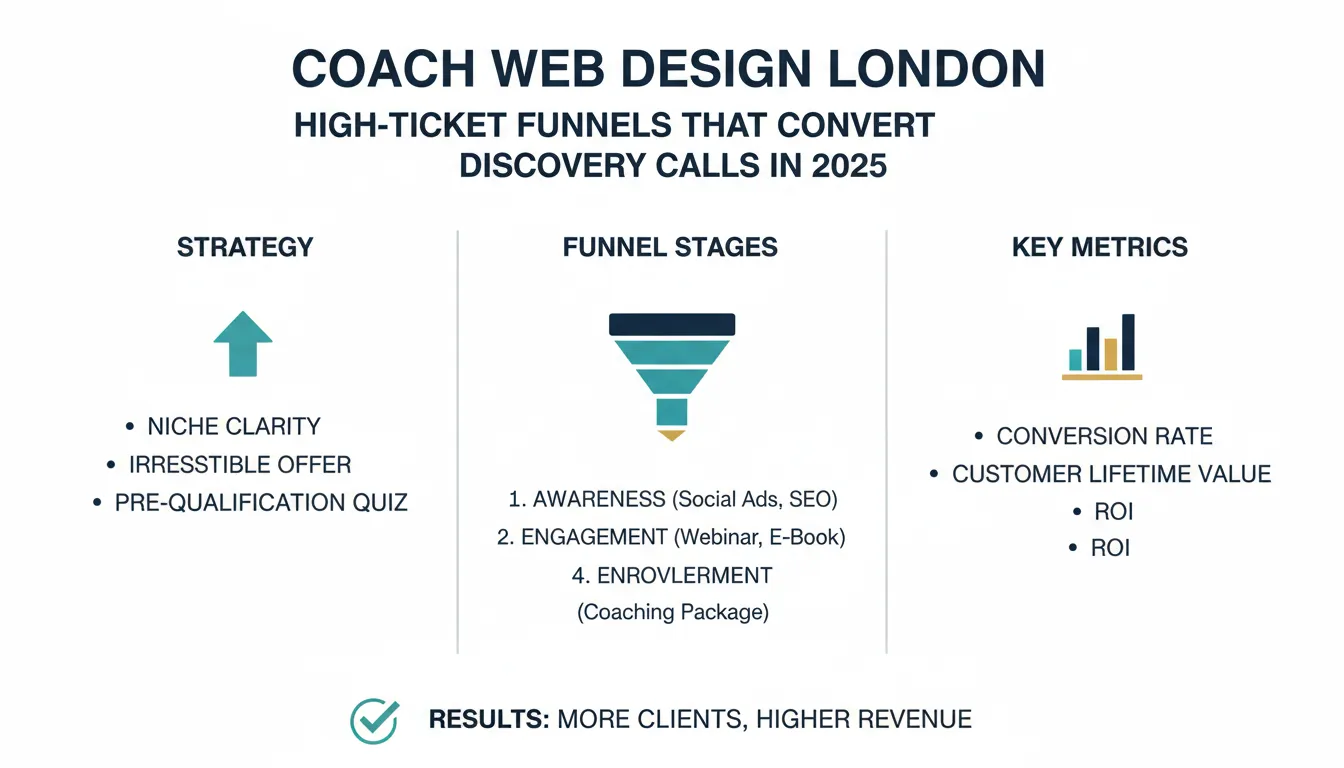
A high-ticket coaching funnel typically includes:
1. Hero section – A compelling headline that speaks directly to your ideal client’s primary problem
2. Value delivery section – Proof that you understand their challenge (through case studies, framework, or philosophy)
3. Social proof – Testimonials, results, credentials, media mentions
4. Application or qualifying gate – A form that filters tire-kickers from serious prospects
5. Discovery call booking – A clear scheduling mechanism (Calendly, Acuity, etc.)
6. Follow-up automation – Email sequences that nurture prospects who don’t book immediately
Each component serves a purpose in the funnel. Remove one, and conversions drop.
Step 1: Audit Your Current Website Against High-Ticket Conversion Standards
Before you redesign or build a new site, you need to understand where you’re currently losing prospects. Most coaches assume their website is “fine.” The data tells a different story.
Start by measuring these metrics:
– Landing page bounce rate – What percentage of visitors leave within 10 seconds? If it’s above 60%, your headline isn’t resonating.
– Discovery call booking rate – Of all site visitors, how many actually book a call? Anything below 2% suggests funnel friction.
– Average time on site – Are people reading your message, or skimming? Less than 45 seconds suggests your copy isn’t compelling.
– Conversion rate by traffic source – Do organic search visitors convert differently than social traffic or email referrals?
Use Google Analytics 4, Hotjar, or similar tools to identify drop-off points. Often, you’ll find that:
– Visitors land on your homepage and leave because your headline doesn’t immediately establish relevance
– People scroll past your value proposition without understanding your specific methodology
– Your social proof is weak (no testimonials, no results, no credentials)
– Your call-to-action is buried, unclear, or appears too “sales-y”
One London-based executive coach we worked with had 8,000 monthly website visitors but only 2-3 discovery call bookings per month (0.025% conversion rate). After auditing her site, we found:
1. Her headline was generic (“Executive Coaching for Leaders”)
2. She had zero testimonials visible above the fold
3. Her discovery call booking button was small and gray
4. Her funnel jumped from “About Me” directly to “Book a Call” without establishing value
We redesigned the funnel using the framework below. Her conversion rate increased to 3.2% (65+ calls per month) within 8 weeks.
Step 2: Build Your Hero Section Around the Specific Problem Your Ideal Client Faces
Your hero section—the first thing visitors see—must immediately establish relevance. In high-ticket coaching, this means speaking directly to the problem your ideal client is experiencing.
Most coaches get this wrong. They lead with their credibility (“10 Years of Experience”). Or their approach (“Transformational Coaching”). Or their values (“I believe in authentic growth”).
High-ticket buyers don’t care about any of that in the first 3 seconds. They care about one thing: Do you understand my problem?
The High-Ticket Hero Formula
Your headline should follow this structure:
[Specific Client] → [Current Frustration] → [Desired Outcome]
Instead of: “Executive Coaching for Leaders”
Use: “Busy London Directors Who Are Stuck at £500K Revenue and Ready to Scale Beyond £1M Without Burning Out”
Notice the difference. The second headline:
– Identifies a specific person (London Directors)
– States a specific problem (stuck at £500K)
– Names a desired outcome (£1M+ without burnout)
– Implies urgency and relevance
Your subheading should then provide a brief reason *why* you’re qualified to help. Not a list of credentials, but a specific outcome you’ve delivered.
Example: “We’ve helped 47 London-based founders and executives scale past their growth plateau in 90 days using our Revenue Architecture Framework™.”
This subheading:
– Gives a number (social proof through specificity)
– Names the transformation (past growth plateau)
– References a methodology (framework)
– Adds a timeframe (90 days)
Visual Design Considerations
Your hero image should show:
– A real person (ideally a client success story) in a context relevant to your niche
– Not a stock photo of someone meditating or smiling at a laptop
– Environmental cues that signal high-ticket positioning (professional office, luxury setting, focused work)
The copy-to-image ratio matters. For high-ticket funnels, 60% copy / 40% image works better than the reverse. You need space to communicate your message clearly.
Step 3: Create a Social Proof Section That Establishes Authority and Trust
High-ticket buyers make decisions based on proof of results. Not credentials. Results.
Yet most coaching websites have either zero testimonials or poorly structured ones. A good testimonial should:
1. Include the client’s name and photo – Anonymous testimonials feel fake
2. Specify the transformation – “Increased confidence” is vague. “Moved from £50K to £150K revenue in 14 months” is specific
3. Include quantifiable metrics where possible – Time saved, revenue gained, clients acquired, confidence levels
4. Be no longer than 2-3 sentences – Longer testimonials don’t get read
5. Be from recognizable/impressive client profiles – A testimonial from a FTSE 100 director carries more weight than from an unknown name
The Testimonial Structure That Works
[Client Name & Title] | [Company Size/Type]
“[Specific before state] → [Specific after state]. The biggest shift was [psychological or practical breakthrough]. I’d recommend this to [target client description].”
Real example from our files:
“Sarah Mitchell | Founder, 7-Figure SaaS Company”
“I was making £250K annually but felt trapped in my business—working 60-hour weeks with constant cash flow anxiety. After 6 months of coaching, I’d hired a COO, systemized our operations, and reduced my working hours to 25/week while revenue grew to £420K. The biggest shift was moving from ‘I need to do everything’ to ‘I need to build a team that can run without me.’ I’d recommend James to any founder feeling like they’ve hit a ceiling.”
Notice:
– Specific numbers (£250K → £420K)
– Specific outcome (25/week hours)
– Psychological breakthrough (“I need to build a team”)
– Relevant to the target audience (founders hitting ceilings)
Structuring Your Social Proof Section
Include at least 3-5 detailed testimonials. Add a section that shows:
– Number of clients served (e.g., “200+ London coaches and consultants”)
– Years in business (if substantial)
– Industry recognition (media mentions, awards, speaking gigs)
– Specific results delivered (aggregate stats, case studies with permission)
One executive coach we worked with had impressive results but hadn’t systematized their proof. We created a “Results Dashboard” showing:
– 127 clients coached in the last 3 years
– Average revenue increase: £180K per client
– Average time to first £100K breakthrough: 18 weeks
– 89% of clients renewed or referred others
This visual proof increased their discovery call booking rate from 1.2% to 3.8%.
Step 4: Design Your Discovery Call Booking Mechanism With Zero Friction
This is where most funnels fail. The call-to-action (CTA) is either:
– Too aggressive (feels sales-y)
– Too passive (feels optional)
– Too far down the page (prospects don’t see it)
– Too complicated (multiple steps, form fields, redirects)
The High-Ticket CTA Strategy
Your primary CTA should appear in three places:
1. In the hero section – A button that says “Book Your Free Strategy Call” or “Apply for Coaching” (placed where 80% of the fold is visible)
2. After social proof – Once you’ve established authority, introduce the CTA again (people at this point are more likely to respond)
3. At the footer – For people who’ve scrolled through your entire message
The button text matters enormously. Avoid:
– Generic: “Contact Us”
– Soft: “Learn More”
– Presumptive: “Get Started Now”
Instead use:
– “Book Your Free Strategy Call” – Specific, clear, builds anticipation
– “Apply for Private Coaching” – Creates a filter (not everyone is accepted)
– “Claim Your Complimentary Consultation” – Implies scarcity and value
The Booking Mechanism Itself
Your discovery call booking should be:
– Direct – Click the button and go straight to your calendar (not a form leading to a page leading to a calendar)
– Reassuring – Show the timezone, expected duration, and what they’ll receive
– Limited – Display availability for only the next 14 days (creates scarcity)
– Social-signaled – Consider showing “4 other London coaches booked this week” (subtle social proof)
Tools that work well:
– Calendly – Simple, free-to-paid, integrates with email and Zoom
– Acuity Scheduling – More sophisticated, better for high-ticket (allows questions before booking)
– HubSpot Meetings – Integrated CRM, better for follow-up automation
We recommend Acuity for high-ticket coaching funnels because it allows you to ask qualifying questions before the call is confirmed. You can filter tire-kickers with questions like:
– “What’s your current annual revenue?”
– “How much are you looking to invest in coaching?”
– “When are you hoping to see results?”
This pre-qualification saves you time and ensures only serious prospects book.
Step 5: Structure Your Funnel Page Layout for Maximum Conversions
The order of your elements matters more than you think. High-ticket buyers scan pages in patterns. Understanding these patterns allows you to guide them toward booking a call.
The Proven High-Ticket Funnel Layout
1. Hero Section (with CTA)
– Headline, subheadline, hero image
– Primary CTA button
– Expected to convert 1-3% of cold traffic
2. Social Proof Section
– 1-2 specific testimonials with photos and metrics
– A “Results Summary” (number of clients, average outcomes)
– Establishes credibility and signals that others like your ideal client have benefited
3. The Problem / Opportunity Section
– What typically happens without coaching (the pain)
– What becomes possible with the right support (the opportunity)
– Should resonate deeply with your ideal client’s current state
4. Your Methodology or Framework
– Briefly explain your approach (not a full course—just enough to establish differentiation)
– Show the steps or stages of your coaching process
– Helps prospects understand what they’re investing in
5. More Social Proof (Case Studies or Results)
– 1-2 detailed case studies showing before/after transformation
– Specific numbers, timeline, and breakthrough moments
– Addresses objections (“Will this work for someone like me?”)
6. Objection Handling Section
– Use an FAQ format addressing common hesitations
– “How long until I see results?”
– “Is this only for people with X background?”
– “What if I’ve worked with other coaches before?”
7. The Value Proposition of a Discovery Call
– Explain what happens during the 30-minute call
– What they’ll walk away with (an insight, a framework, a plan)
– Make it feel valuable (not a “sales call” but a genuine strategy session)
8. Secondary CTA
– “Book Your Free Strategy Call”
– Different copy than the hero CTA, but same destination
9. Trust Signals
– Security badges, payment icons (if applicable)
– Contact information or business registration number
– Response time promise (“We’ll confirm within 24 hours”)
10. Footer CTA
– Final opportunity to book a call
– Email capture as backup (for those not ready yet)
This structure works because it mirrors the high-ticket buyer’s journey:
1. Relevance – Does this apply to me?
2. Authority – Are you credible?
3. Differentiation – Why you vs. others?
4. Social proof – Have you delivered results?
5. Risk reversal – What’s in it for me?
6. Clear next step – How do I get started?
A London-based business coach using this layout saw conversion improvements of 180% within 6 weeks. Her old site had the booking button buried at the bottom of an “About Me” page. Her new funnel introduced the CTA at the hero, after testimonials, and again at the footer. Her booking rate went from 0.8% to 2.3%.