Your website is often the first impression potential customers have of your dealership. Yet many London car dealers struggle with poorly designed stock pages, confusing finance options, and mobile experiences that push buyers toward competitors.
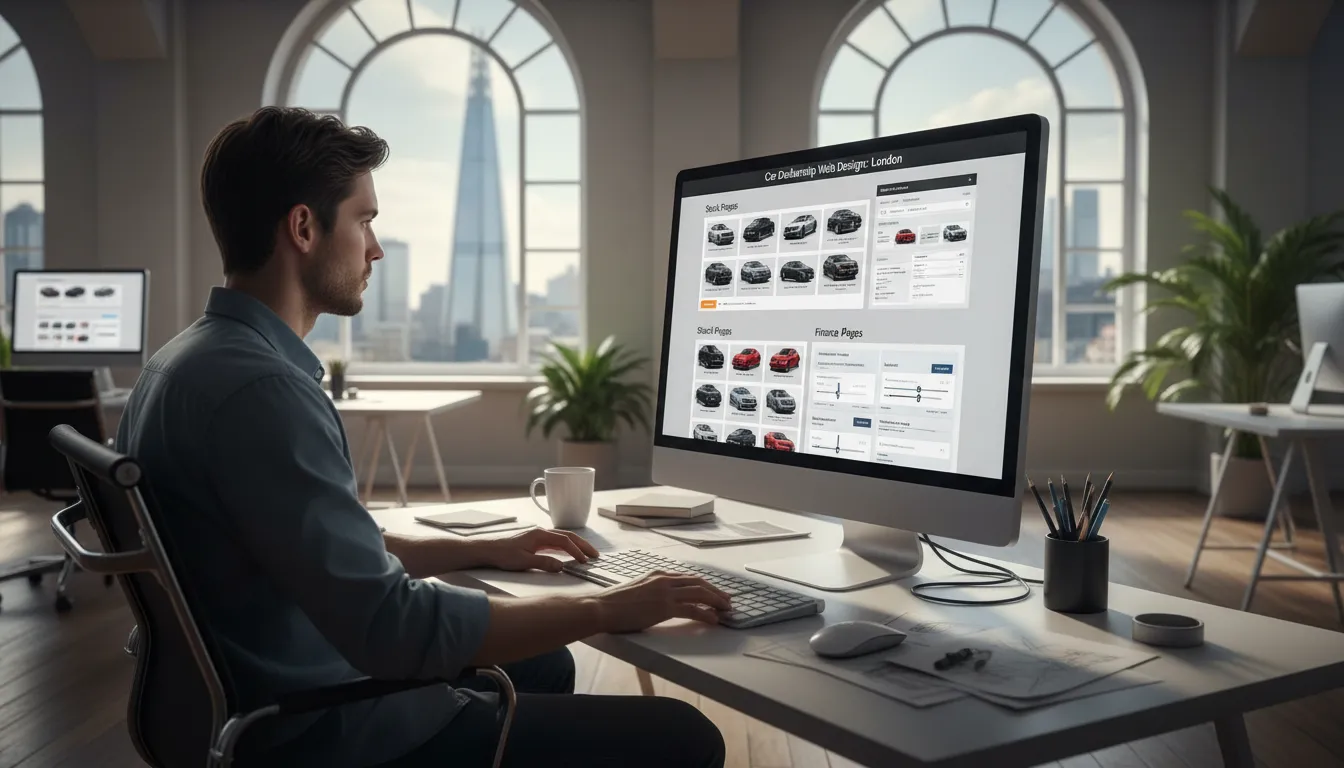
Here’s the reality: 78% of car buyers research vehicles online before stepping foot in a showroom. If your website doesn’t showcase your inventory professionally, explain finance options clearly, and make the buying process feel straightforward, you’re losing sales to dealerships that do.
We’ve helped 200+ London businesses—including car dealerships—build websites that don’t just look good. They convert browsers into qualified leads, reduce customer support queries, and build trust in a competitive market. This guide covers everything you need to know about creating a web design strategy that works specifically for car dealerships in London, with special focus on stock pages and finance sections that actually sell vehicles.
Key Takeaways
What Is Car Dealership Web Design? Why It Matters for London Dealers
Car dealership web design isn’t just about pretty pictures of vehicles. It’s a strategic tool that addresses the unique needs of modern car buyers while reflecting your dealership’s credibility and professionalism.
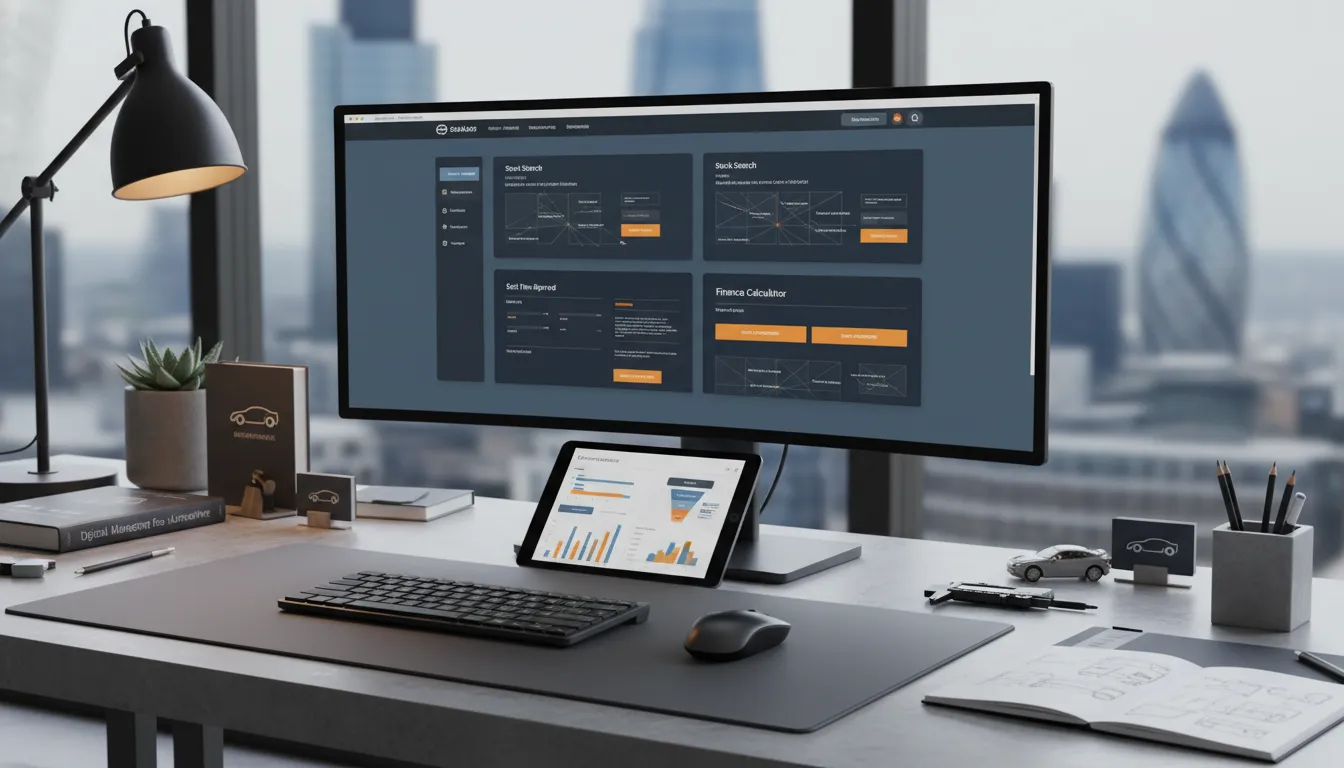
A proper automotive website serves multiple critical functions:
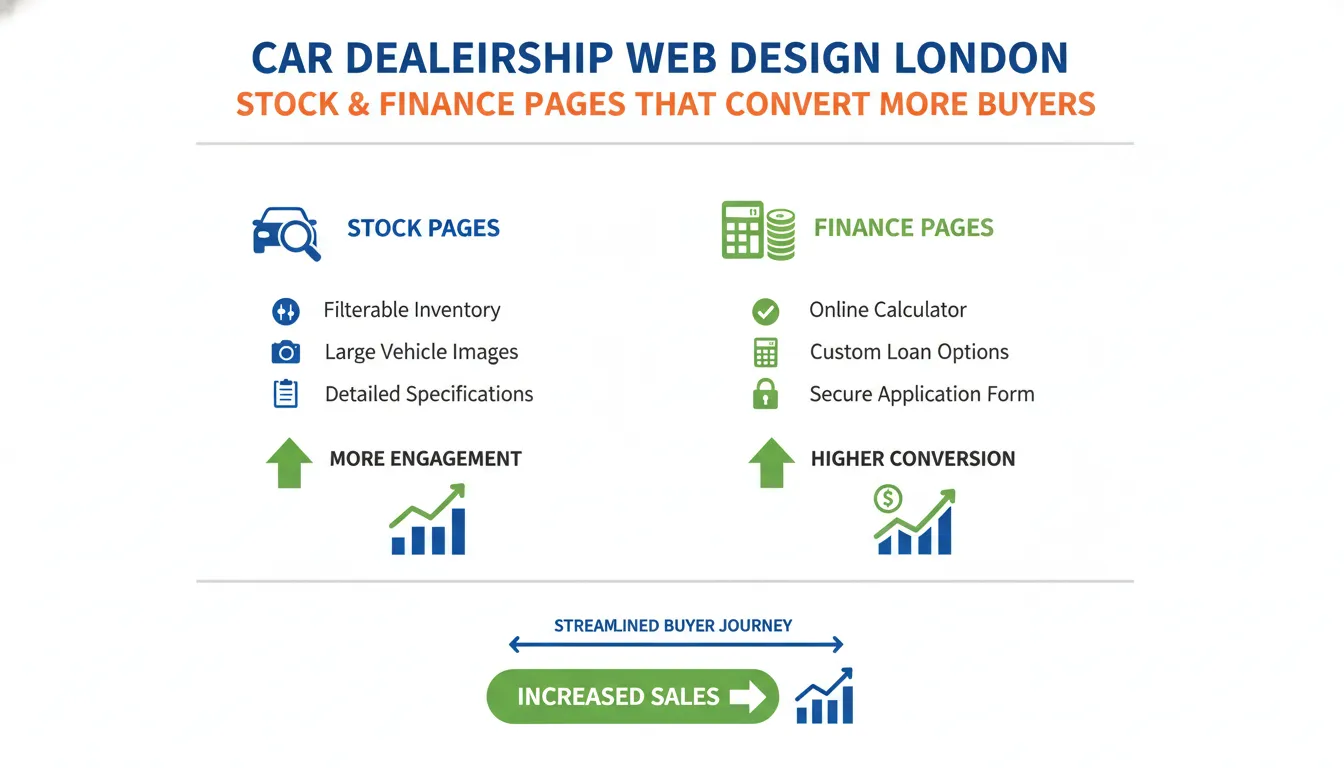
Showcases Your Inventory Effectively. Customers want to filter by make, model, price range, mileage, and features. A poorly organised stock page forces them to call you or visit competitors. A well-designed inventory system lets them self-serve, qualify leads, and spend more time engaged with your brand.
Simplifies Finance & Funding Options. Most car buyers need financing. Your website should make finance options transparent, offer calculators, and explain PCP vs HP vs leasing in plain English. Confused customers don’t buy.
Builds Trust & Credibility. A professional website with clear contact information, reviews, credentials, and team bios tells customers you’re legitimate and established. In a market where trust is fragile, this matters enormously.
Generates Qualified Leads 24/7. A website doesn’t close sales, but it qualifies them. Customers who fill out a “request viewing” form or finance enquiry form are pre-qualified and ready to engage. This beats cold calling by miles.
Reduces Support Burden. Frequently asked questions about finance, delivery, warranties, and vehicle specs should be on your website. Every answer you provide online is a phone call you don’t receive.
Improves Local SEO. When someone in Canary Wharf or Croydon searches “used car dealership near me,” you want to appear. Local SEO requires location pages, proper schema markup, and content that proves you serve London.
For London dealerships specifically, the web design challenge is unique. You’re competing against national chains, online-only retailers, and dozens of local competitors. Your website needs to prove that you’re worth visiting in person, not just buying from an app.
Core Elements of High-Converting Car Dealership Websites
Every successful automotive website has foundational elements that work together. Miss any of these, and your conversion rate suffers.
Professional Hero Section with Trust Signals. Your homepage needs a clear headline (“Browse 250+ Vehicles | Same-Day Finance Approval”) supported by trust signals: years in business, customer reviews, accreditations, stock quantity. No dealership should have a vague homepage. It’s your handshake.
Advanced Vehicle Filtering System. Visitors should filter by make, model, price, mileage, fuel type, transmission, colour, and features. Every filter removed is a visitor lost. A dealership with 500 vehicles needs better search than one with 50. Invest in proper inventory management software integrated with your website.
High-Quality Vehicle Photography & Video. A single photo isn’t enough. Each vehicle needs 15-20 images covering exterior, interior, engine bay, and close-ups of any damage. Videos showing walk-arounds and test drives perform 10x better than static images. In London’s competitive market, video separates the professionals from amateurs.
Detailed Vehicle Descriptions. “2019 Ford Focus” is useless. Write: “2019 Ford Focus 1.5 TDCi EcoBlue Titanium, 45,000 miles, full Ford service history, recently replaced brake pads, air-con re-gassed, immaculate interior.” Include vehicle history, MOT status, any warranties, and what makes this unit special.
Finance Calculator & Clear Pricing. Transparency wins. Your finance page should include a calculator where customers enter purchase price, deposit, and term to see monthly payments instantly. Show all finance options: PCP, HP, leasing, personal loans, and outright purchase. Hide pricing and you look evasive.
Part-Exchange Valuation Tool. Many buyers want to trade in their old vehicle. An online valuation tool (even if basic) shows you take part-exchange seriously and encourages engagement.
Trust-Building Social Proof. Customer reviews, testimonials with names and photos, star ratings, and Google reviews embedded on your site build credibility. Dealerships with no reviews look risky. Aim for 4.5+ stars with at least 50 reviews.
Clear Contact & CTA Buttons. “Request Viewing,” “Get Finance Quote,” “Enquire Now”—these should appear on every vehicle listing and finance page. Make CTAs obvious and reduce form fields to essentials only.
Mobile Optimization. 65% of car searches happen on mobile devices. If your website isn’t fully mobile-responsive, with thumb-friendly buttons and fast load times, you’re losing customers. Period.
Building a Stock Page That Converts Browsers Into Test Drives
Your stock page is the workhorse of your website. It’s where serious buyers spend the most time. Get this wrong, and you lose sales before a customer ever calls you.
Step 1: Organize Inventory by Customer Intent. Don’t just list all vehicles in one endless scroll. Create logical categories:
– New Arrivals (high conversion—fresh stock creates urgency)
– Best-Selling Models (helps browsers quickly find popular choices)
– Deals & Offers (vehicles with discounts or special finance)
– By Make/Model (crucial for brand-loyal shoppers)
– By Price Range (allows self-qualification)
– By Fuel Type (increasingly important as buyers shift to electric)
Each category should have a dedicated page or filter. A dealership with a proper stock management system integrates this directly with the website. Updates happen automatically—no manual uploading.
Step 2: Create a Powerful Filtering System. Your customers should be able to narrow down 500 vehicles to 10 in under 30 seconds. Essential filters include:
– Make & Model
– Price Range (slider, not fixed boxes)
– Mileage / Year
– Fuel Type (Petrol, Diesel, Electric, Hybrid)
– Transmission (Manual, Automatic)
– Color
– Features (Sat-nav, Leather, Sunroof, Four-Wheel Drive, etc.)
– Finance Options Available (quick indicator)
Advanced dealerships also filter by transmission type, body style, and service history status. The more relevant the filter, the faster browsers narrow their choices.
Step 3: Photography That Sells Vehicles. Professional photography isn’t optional. Each vehicle needs:
– Exterior shots: Front 3/4, side profile, rear 3/4, straight-on front, detail of any damage or wear
– Interior shots: Driver’s seat view, cabin overview, dashboard, steering wheel, trim details, condition of seats and carpets
– Engine bay shot
– Close-ups of features: Wheels, lights, trim details, any special additions
– Full walk-around video (60-90 seconds showing the vehicle from all angles)
Budget £150-300 per vehicle for professional photography. It’s the difference between a vehicle sitting on your lot for months and selling in weeks.
Step 4: Write Compelling Vehicle Descriptions. Move beyond spec sheets. Include:
– Year, Make, Model, trim level, engine size
– Mileage and fuel consumption (MPG)
– Transmission type, drive train
– Color and upholstery
– Full service history or maintenance record
– Any new parts fitted recently
– Warranty details
– Unique features or reasons this car is special
Example: “2020 BMW 3 Series 320d Efficiency Dynamics. 28,000 miles. Full BMW service history. Recently replaced brake fluid, new front tyres, air-con re-gassed. Factory sat-nav, leather, sunroof, electric seats. One owner, clean interior. Ready for immediate collection or delivery to London, Essex, or surrounding areas.”
That’s 2-3 times better than vague listings. It answers 80% of buyer questions instantly.
Step 5: Display Pricing Transparently. Show three price lines:
– Cash Price: What they pay if buying outright
– Finance Option #1: PCP or HP with typical terms (e.g., “£249/month on PCP, £2,000 deposit”)
– Part-Exchange Estimate: “Trade-in value from £X” if applicable
Never hide pricing or show “price on request.” Transparency converts more leads than secrecy ever will.
Step 6: Add a “Request Viewing” CTA on Every Listing. This should be prominent, easy-to-click, and require minimal information:
– Name
– Phone Number
– Email
– Preferred Viewing Time(s)
Optional fields (not required) might ask about finance interest or part-exchange.
Creating Finance Pages That Educate & Convert
The finance section is where dealerships either gain trust or lose it. Complicated jargon, hidden fees, and unclear options push buyers away. Transparent, well-organized finance pages do the opposite.
Step 1: Explain Finance Options Simply. Most buyers don’t know the difference between PCP, HP, and leasing. Your website should explain each in plain English:
Personal Contract Hire (Leasing): “You rent the vehicle for 2-4 years. Monthly payments include insurance and maintenance. At the end, you return it. Best for: Drivers who like new cars, low mileage, minimal responsibility.”
Personal Contract Purchase (PCP): “You pay a deposit, then monthly payments. At the end (typically 3 years), you pay a final balloon payment to own it, or hand it back. Monthly payments are lower than HP because you’re only paying for the vehicle’s depreciation. Best for: Buyers who want to change vehicles regularly and like predictable monthly costs.”
Hire Purchase (HP): “You pay a deposit, then monthly payments over 24-60 months until the vehicle is yours. Total cost is higher than PCP, but you own it at the end. Best for: Buyers planning to keep the vehicle long-term and want full ownership.”
Personal Loan: “You borrow money from a bank independently, then buy the vehicle outright. Interest rates depend on credit score. Best for: Buyers with good credit wanting flexibility and ownership from day one.”
Add icons, comparison tables, and examples. A visual breakdown converts better than paragraphs.
Step 2: Install a Finance Calculator. This is critical. Visitors should enter:
– Vehicle price
– Deposit amount (or percentage)
– Loan term (24, 36, 48, 60 months)
– Finance type (HP, PCP, leasing)
The calculator instantly shows estimated monthly payment, total interest, and APR. This removes friction and lets buyers self-serve. Many dealerships see 2-3x more finance enquiries after adding a calculator.
Step 3: Display Eligibility & Approval Timeline. Buyers want to know:
– “What’s the minimum deposit?” (Usually 10-20%)
– “How quickly can I be approved?” (Usually same-day or next working day)
– “What credit score do I need?” (Be honest; some lenders accept poor credit)
– “What documents do I need?” (Driving licence, proof of address, bank statements, proof of income)
Step 4: Build Trust with FAQs & Guarantees. Address common concerns:
– “Can I change my mind after signing?”
– “What happens if I exceed mileage on PCP?”
– “Are there early settlement fees?”
– “Can I negotiate the APR?”
– “What if my circumstances change?”
Honesty here builds trust. Dealerships that answer these questions see fewer complaints and more completed sales.
Step 5: Offer a Finance Enquiry Form. Separate from the vehicle viewing form, a finance enquiry form should allow visitors to ask about specific vehicles or general finance questions. Keep it simple:
– Vehicle interest (optional, select from dropdown)
– Preferred finance type
– Approximate budget
– Contact information
This pre-qualifies customers and gives your team time to prepare a quote before the customer arrives.
Step 6: Feature Finance Options on Every Vehicle Page. Don’t make customers navigate to a separate finance calculator. Each vehicle listing should show:
– Cash price
– Estimated monthly payment (PCP example)
– Estimated monthly payment (HP example)
– Finance enquiry button
This removes barriers to engagement.
Technical SEO & Performance: Making Your Site Visible to London Buyers
A beautiful website means nothing if no one finds it. Technical SEO ensures your site ranks for “car dealership London,” “used cars London,” and specific model searches.
Local SEO for Dealerships. Your business needs to appear in Google Maps and local search results:
– Claim and optimize your Google Business Profile with accurate hours, address, phone, and high-quality photos
– Create location pages if you have multiple branches (e.g., “Used Cars in Croydon,” “Used Cars in Canary Wharf”)
– Add schema markup (LocalBusiness, Vehicle schemas) so Google understands your inventory
– Build citations on automotive directories: Autotrader, Motors.co.uk, Car Throttle
– Encourage customer reviews on Google, Trustpilot, and industry-specific platforms
Keyword Targeting for Dealerships. Target keywords at each stage of the buyer journey:
– Awareness: “Used cars London,” “Best car dealerships London,” “Car finance explained”
– Consideration: “Used BMW London,” “PCP vs HP,” “Part-exchange valuation”
– Decision: “2020 Ford Focus price London,” “Request viewing,” “Finance calculator”
Create content around each stage. Blog posts, comparison guides, and finance explainers naturally rank for these keywords and build authority.
Core Web Vitals & Mobile Performance. Google’s ranking algorithm heavily weights:
– Page load speed (target: under 3 seconds on mobile)
– Mobile responsiveness (must work perfectly on all screen sizes)
– Visual stability (no layout shifts that frustrate users)
Optimize images (compress without losing quality), minimize code, enable caching, and use a content delivery network (CDN). Lazy-load images so vehicles load as users scroll. A dealership with 500 vehicles needs aggressive optimization.
Vehicle Schema Markup. This tells Google about your inventory:
With proper schema, Google shows your vehicles directly in search results with photos, price, and availability. This dramatically improves click-through rates.
Inventory Integration. Your website should sync automatically with your stock management system. New arrivals appear within hours, sold vehicles disappear instantly. Manual updates are slow and error-prone.
Tools, Platforms & Cost Breakdown for London Dealerships
Building a professional automotive website requires the right tech stack. Here’s what you need and typical London pricing:
| Component | Platform/Tool | Cost (Monthly) | Notes |
|———–|————–|———|——-|
| Website Builder | Dealer-specific CMS (