Your logistics website is often the first impression potential clients have of your delivery business. Yet most courier companies in London are still operating with outdated, clunky websites that fail to capture enquiries, confuse visitors with poor navigation, and lose contracts to competitors with better online presence. According to recent research, 75% of users judge a company’s credibility based on website design alone. For logistics and courier companies, a professional website isn’t a luxury—it’s a necessity.
The harsh reality? A poorly designed logistics website costs you money every single day. Potential clients visit your site, can’t find key information like service areas or pricing, struggle on mobile devices, and bounce to your competitors within seconds. Meanwhile, you’re paying for marketing to drive traffic to a site that doesn’t convert. This is where professional logistics web design in London changes the game. We specialize in building custom, conversion-focused websites specifically designed for courier companies, delivery services, and logistics providers. From responsive mobile design to integrated quote request systems, we handle every detail that drives real business results.

In this comprehensive guide, you’ll discover exactly how professional web design transforms a logistics business in London. We’ll walk you through what makes a logistics website effective, show you the step-by-step process of getting your own custom site live, break down costs and timelines, and share real-world examples of courier companies that dramatically increased their enquiries after redesigning their web presence.
What Makes a Logistics Website Different From Standard Web Design
A logistics website isn’t just about looking nice. It’s a specialized tool that needs to handle specific business requirements unique to the courier and delivery industry. Unlike event planners or service providers, logistics companies need websites that communicate complex information clearly, build trust with enterprise clients, and integrate with operational systems.
Key Takeaways
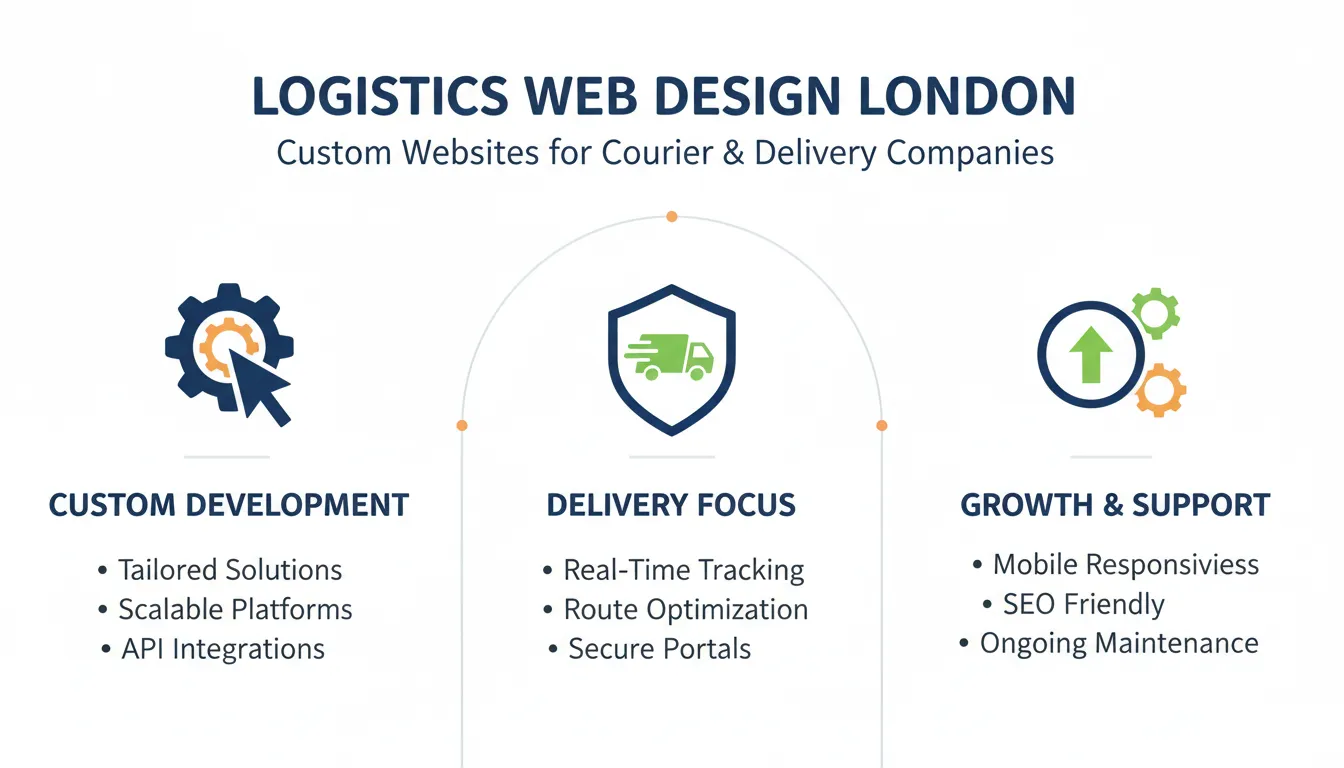
Key differences in logistics web design include:

Real-time tracking capabilities: Clients expect to see live parcel tracking or, at minimum, clear messaging about your tracking systems. Your website must explain how clients can monitor their deliveries, whether through your own tracking portal or integrations with industry-standard systems.
Service area mapping: Unlike a local salon, courier companies often serve multiple regions, cities, or even international areas. Your website needs clear, visual representation of where you operate, with details about next-day delivery zones, international coverage, and pricing variations by region.
Trust signals and certifications: Logistics clients care deeply about reliability. Your website must prominently display certifications (ISO standards, DfT compliance, environmental credentials), insurance information, and proven track records. Enterprise clients won’t even consider using you without this visible on your site.
Transparent pricing and quote systems: Courier companies rarely have one-size-fits-all pricing. Your website needs an integrated quoting system where clients can input parcel weight, dimensions, destination, and service level to get instant quotes. This reduces back-and-forth emails and speeds up the sales process.
Mobile optimization for on-the-go clients: Many of your clients will be SME business owners or logistics managers who need quick information while mobile. A non-responsive website is a dealbreaker.
Clear call-to-action for quotes and enquiries: Every page needs a simple, obvious way to request a quote or contact your team. Multiple CTAs across your site reduce friction in the customer journey.
Integration capabilities: Modern logistics websites often need to connect with booking systems, payment gateways, or inventory management platforms. Your site needs to be built with flexibility to add these integrations without major rebuilds.
These specialized requirements mean that a generic website template won’t cut it. Logistics companies need purpose-built solutions that address their unique business model and customer expectations.
Step-by-Step Process: Getting Your Logistics Website Live in 7 Days
Getting a professional courier website live doesn’t require months of waiting or massive budgets. We deliver custom logistics websites in just 7 days, starting from £499. Here’s exactly how the process works:
Day 1-2: Discovery, Strategy & Content Planning
The first step is understanding your business deeply. This isn’t a generic “tell us about your company” conversation. During the discovery phase, we’re asking specific logistics business questions:
– What services do you offer? (Same-day delivery, parcel delivery, freight, international shipping, specialized handling?)
– Who are your ideal clients? (E-commerce businesses, SMEs, enterprises, specific industries?)
– What geographic areas do you service?
– How do you currently handle quote requests? (Phone calls, email forms, online system?)
– What’s your current conversion rate from website visitor to qualified lead?
– Who are your main competitors, and what’s working (or not working) on their sites?
– Do you have existing content, branding, and messaging we should use?
From this discovery, we create a strategic brief that outlines your website’s purpose, target audience segments, key messages, and conversion goals. We also plan your content hierarchy—what information appears where to guide visitors naturally toward taking action (requesting a quote, calling your team, or booking a service).
Pro tip: Come prepared with 3-5 competitor websites you like. This saves significant time and ensures we build exactly what you envision.
Day 2-3: Design & Layout Creation
With strategy locked, our design team creates custom mockups for your key pages. For a typical logistics website, this includes:
– Homepage: Hero section showcasing your key differentiators, service overview, service area map, and CTAs
– Services page: Detailed breakdown of each service you offer with pricing, timelines, and eligibility criteria
– About page: Company story, team credentials, and client testimonials
– Tracking page: Explanation of how clients track their deliveries
– Quote/Contact page: Quick-quote form and contact options
– FAQ page: Addressing common customer questions about your services
Each page is designed to be mobile-first, meaning it looks great on phones before scaling up to tablets and desktops. We use clean, professional design that reflects the reliability and efficiency of your logistics brand.
Design best practices for logistics:
– Use calming, professional colors (blues, greys, clean whites) that communicate trust and professionalism
– Include actual photos of your team, vehicles, and operations (not generic stock images)
– Make service area maps highly visible and easy to understand
– Use icons and visual hierarchy to break up text-heavy content
– Ensure CTAs stand out with contrasting colors and clear messaging
Day 3-4: Development & Build
Once designs are approved, our developers build your website using professional frameworks that ensure fast load times, security, and scalability. We use:
– Responsive frameworks: Built for mobile-first experiences with perfect scaling to desktop
– Content management systems: So you can update pricing, service areas, or testimonials without technical knowledge
– Integration-ready architecture: Whether you need quote forms, payment processing, or tracking system connections, the foundation is built to handle it
During development, we’re also setting up:
– SSL security certificates (the green padlock icon users trust)
– Analytics tracking so you can monitor visitor behavior and conversion rates
– SEO foundations (clean code, proper heading structure, mobile optimization)
– Backup and security systems to protect your business data
Day 4-5: Content Population & Integration
Your website is taking shape. Now we populate it with compelling, SEO-optimized copy that speaks directly to your target audience. Unlike generic website copy, we write specifically for logistics decision-makers:
– Explaining your service benefits in terms of their business outcomes (faster deliveries = happier customers = more repeat business)
– Addressing objections (What if a parcel gets damaged? How do you handle international customs?)
– Using confidence-building language (established track record, insurance details, certifications)
– Creating CTAs that feel natural and non-pushy
We also integrate any tools you need:
– Quote request forms that automatically send information to your team
– Live chat systems so visitors can ask questions immediately
– Email capture systems for building your mailing list
– Analytics tools to track page performance and visitor behavior
Day 5-6: Testing & Quality Assurance
Before going live, we put your website through rigorous testing:
– Cross-browser testing: Does it look perfect on Chrome, Safari, Firefox, and Edge?
– Device testing: Testing on actual phones, tablets, and desktops to catch responsive design issues
– Form testing: Ensuring quote requests, contact forms, and integrations work flawlessly
– Load time testing: Checking that pages load in under 3 seconds on mobile and desktop
– Link checking: Verifying all internal and external links work correctly
– Accessibility testing: Making sure users with disabilities can navigate your site
Any issues found are fixed immediately. We also do a full content review for spelling, grammar, and brand consistency.
Day 6-7: Launch & Optimization
Your website goes live. We:
– Set up DNS records and domain configuration
– Configure email forwarding so quote requests reach the right team members
– Install Google Analytics and Search Console for ongoing monitoring
– Set up Google Business Profile if you haven’t already
– Create a handover document explaining how to update your website
– Provide initial SEO optimization recommendations
Within the first week, we’re also monitoring your site’s performance—checking load times, tracking errors, and beginning the process of optimizing for your target keywords.
Important: Launch isn’t the end. Professional websites require ongoing optimization based on visitor behavior data and changing business needs. We recommend quarterly reviews to ensure your site continues converting visitors into qualified leads.
Essential Features Every Logistics Website Needs
Beyond the design and development process, certain features are non-negotiable for courier and delivery company websites in London. Missing even one can significantly impact your ability to capture enquiries:
Live Quote System
This is the #1 converter for logistics websites. Instead of making clients call or email for pricing, they enter their parcel details and instantly see your rates. This speeds up the sales process and qualifies leads before they contact your team.
What your quote system should include:
– Weight and dimension inputs
– Pickup and delivery location fields
– Service level selection (next-day, economy, express, etc.)
– Special handling requirements (fragile, temperature-controlled, hazardous)
– Instant quote display with estimated delivery date
– Option to request a quote or book immediately
Service Area Map
Courier clients want to know immediately if you service their area. An interactive map showing your coverage zones, next-day delivery areas, and special service regions builds confidence and eliminates the “let me check if we service that area” back-and-forth.
Client Testimonials & Case Studies
“We’ve delivered over 5 million parcels” is good. “TechStart Ltd increased their delivery capacity by 40% using our services and saved £50k annually” is better. Specific, quantifiable results from recognizable clients (with permission to name them) are incredibly persuasive.
Track Your Parcel Section
Even if you don’t have a fully integrated tracking system, your website should explain how clients access tracking information. This might be linking to a third-party tracking system, explaining your email notification process, or showcasing your mobile app capabilities.
Mobile-First Responsive Design
Non-negotiable. Over 60% of logistics enquiries now come from mobile devices. If your site doesn’t work on phones, you’re losing real business.
Fast Load Times
Page speed is both a user experience and SEO factor. Sites that load in under 3 seconds have significantly higher conversion rates than slow sites. We optimize images, use content delivery networks, and clean code to ensure speed.
Clear Service Descriptions
Don’t assume visitors understand what “next-day parcel delivery with tracking” means. Explain it simply: “We guarantee your parcel arrives by 10am the next business day. You’ll receive a tracking code via email so you can monitor its progress in real-time.”
Multiple Contact Methods
Some clients prefer calling. Others want to email or use chat. Provide options: phone number prominently displayed, email form, live chat during business hours, and contact information for specific departments (accounts, operations, urgent deliveries).
Tools, Technology & Cost Breakdown for Logistics Web Design London
Building a professional logistics website involves various tools, integrations, and investments. Here’s what you need to know:
Technology Stack We Use
| Component | Purpose | Cost Range |
| ———– | ——— | ———– | <br /> |
|---|---|---|---|
| Domain Registration | Your online address (yourcompany.com) | £10-20/year | |
| SSL Certificate | Security encryption (the green padlock) | Included/£50-200/year | |
| Web Hosting | Server space for your website | £15-50/month | |
| CMS Platform | Content management system for updates | Varies (WordPress £0, proprietary £500+) | |
| Quote System Integration | Live pricing calculator | £200-500 setup, £50-200/month | |
| Email Service Provider | Managing subscriber lists and automation | £20-100/month | |
| Analytics Tools | Google Analytics, heat mapping | £0-500/month | |
| Security/Backup Systems | Protecting your data | £50-200/month | |
| CDN (Content Delivery Network) | Speeding up page loads globally | £20-100/month |
Pricing Model: What You Actually Pay
Our standard offering: From £499 for a custom logistics website, delivered within 7 days.
This £499 investment typically includes:
– Custom design (not a template)
– 5-8 core pages (homepage, services, quote page, about, contact, FAQ, tracking explanation, blog)
– Mobile-responsive development
– Basic SEO optimization
– Contact/quote forms
– Google Analytics setup
– 1 month of support included
Add-on costs (depending on your specific needs):
– Advanced quote system with integration: £300-800
– Live chat functionality: £100-300
– Blog setup and initial content (5 posts): £500-1000
– Professional photography of your operations: £500-1500
– Video production (testimonials, service explanations): £1000-3000
– Email automation setup: £200-500
– Advanced SEO package (competitor analysis, keyword research, content strategy): £500-1500
– Monthly maintenance and updates: £100-300
Real-World Cost Example
A typical London courier company might invest:
– Initial build: £499
– Advanced quote system: £500
– Photography package: £800
– Initial blog content (5 posts): £500
– First 3 months support/maintenance: £300
– Total Year 1 investment: ~£2,600
For context, most of our clients report generating their website’s cost back in additional enquiries within the first month. A single enterprise client worth £5,000+ makes the entire investment worthwhile.
Why We Can Deliver So Quickly & Affordably
You might wonder: how can we deliver a custom website in 7 days for £499? Aren’t websites expensive and slow to build?
The answer lies in our process:
1. Specialization: We build logistics websites constantly. We’re not starting from scratch each time; we have proven patterns, templates, and integrations that dramatically speed development.
2. Streamlined discovery: Unlike agencies that spend weeks in meetings, we get clarity in focused 30-minute conversations. We ask specific questions and move forward with decision-making.
3. Fixed scope: We define exactly what’s included in the £499 package. This prevents scope creep that delays projects and inflates costs.
4. Automation: We automate repetitive tasks (form setup, analytics installation, email integration) that other agencies handle manually.
5. Technology stack: We use proven, efficient technology that reduces development time without sacrificing quality.
6. Lower overhead: As a focused agency, we don’t carry the massive overhead of large digital agencies. We pass those savings to you.
This doesn’t mean we cut corners. Every website meets professional standards for design, speed, security, and conversion optimization. It means we’re efficient with our process.
Comparing Logistics Web Design Options in London
When considering where to build your logistics website, you have several options. Here’s how they compare:
| Option | Cost | Timeline | Customization | Support | Best For |
|——–|——|———-|————–|———|———-|
| DIY Website Builders (Wix, Squarespace) | £200-500 setup + £