The Problem: Why Most London Plumbers Are Losing Money Without a Website
Every minute a homeowner searches Google for “emergency plumber near me,” there’s a plumber in London getting that call. But is it you?
Here’s the reality: 78% of homeowners search online before calling a plumber. That’s not a guess. That’s how modern emergency home repairs work. Someone discovers a leak at 11 PM, grabs their phone, opens Google, and the first plumber they see gets the job. The question is: will that be you?
For too many London plumbers, the answer is no. They’re good at what they do—fixing pipes, solving boiler problems, handling emergencies. But online? They’re invisible. No website. No Google reviews. No way for customers to find them when they’re desperately searching for help. Meanwhile, competitors with better online presence are stealing their jobs. Not because they’re better plumbers. Just because they’re easier to find.
Key Takeaways
This isn’t a luxury problem anymore. It’s a survival problem. A professional website isn’t just nice-to-have. It’s the difference between a thriving plumbing business and one that struggles month to month. But here’s where most plumbers get stuck: they think a website has to be expensive. They’ve heard horror stories about £3,000-£5,000 websites that take months to build and don’t even work. They’ve been quoted crazy prices by agencies that treat a plumber’s website like it’s rocket science.
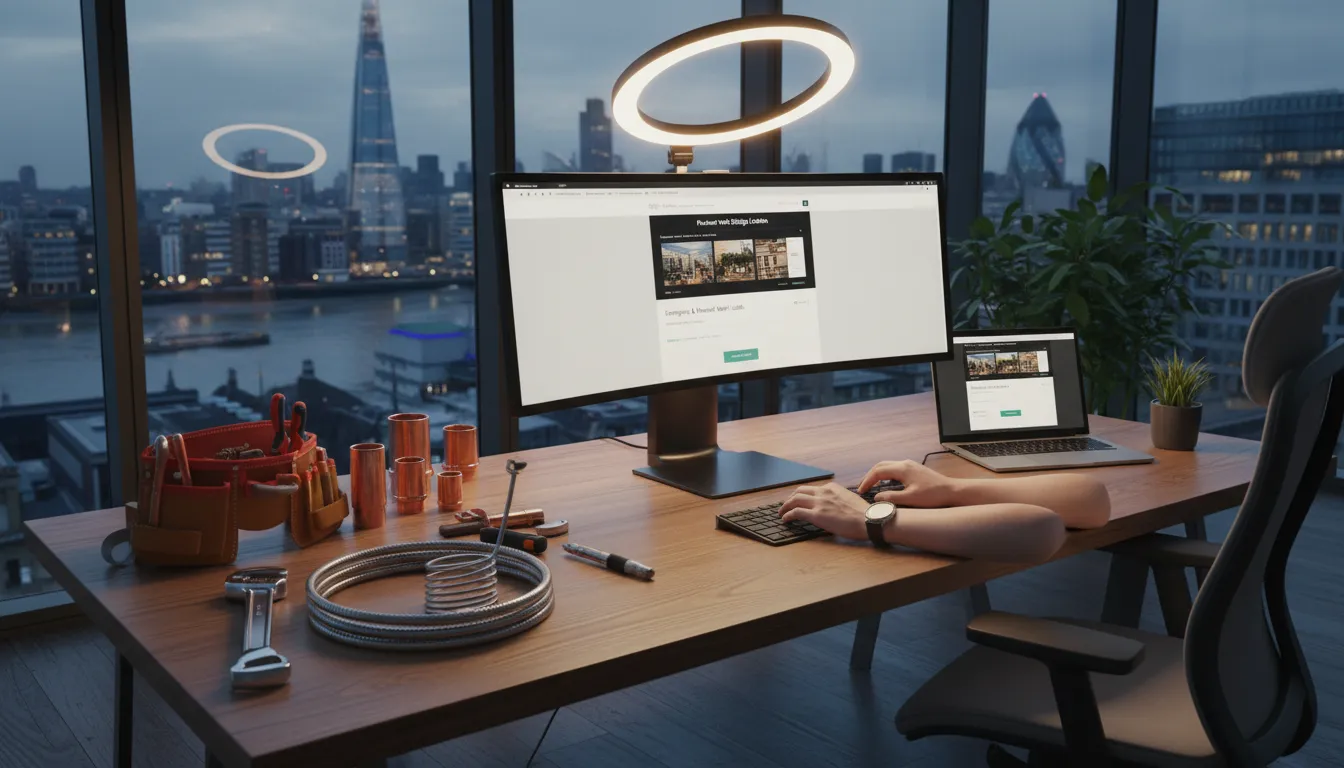
It doesn’t have to be that way. A professional, lead-generating plumber website can be live in 7 days from just £499. No jargon. No long contracts. No waiting around.
What a Professional Plumber Website Actually Does
A plumber website isn’t just a digital business card. It’s a 24/7 salesperson working for you while you’re fixing pipes at 2 AM.
Here’s what it actually does:
Captures Emergency Calls. When someone’s kitchen is flooding at midnight, they don’t care what day it is. They search Google, they need your number, and they need it now. A website puts you in front of them in seconds.
Builds Trust Before They Call. A professional website with customer testimonials, clear pricing, and information about your experience tells people you’re legitimate. You’re not some fly-by-night operation. You’re an established local plumber they can rely on.
Shows What You Do. Not every plumber handles everything. Maybe you specialize in boiler repairs. Maybe you focus on emergency call-outs. Maybe you do full bathroom installations. A website explains exactly what services you offer, so customers know if you’re the right fit before they even call.
Captures Information. A contact form or enquiry system means customers can tell you about their problem before the call. “I have a boiler that won’t fire up” is way more useful than a blank phone call.
Works While You Sleep. Your van is in the driveway. You’re sleeping before tomorrow’s 6 AM call-out. Your website is still getting leads. That’s not a gimmick. That’s efficiency.
Helps You Compete. In London, there are thousands of plumbers. Most don’t have websites. The ones that do are getting more work. A professional site puts you in that small group of visible, credible options.
A plumber website does one job: it gets people who need your service to contact you. Everything else is secondary.
How to Get a Professional Plumber Website in London (7-Day Process)
Building a website used to mean months of back-and-forth, confusing technical meetings, and contractors who didn’t understand your business. That’s not how this works.
Step 1: Brief Your Needs (Day 1)
Everything starts with clarity. You’ll spend 30 minutes on a call (or via email) explaining your business:
– What services do you offer? (Emergency call-outs, planned maintenance, boiler repairs, bathroom installations, etc.)
– What areas do you cover in London? (Specific postcodes or boroughs?)
– Who are your ideal customers? (Residential homeowners, landlords, letting agents?)
– Do you have existing branding? (Logo, colors, fonts?)
– Do you have customer testimonials or case studies?
This isn’t complicated. It’s just getting specific so your website actually represents your business. No guessing. No vague assumptions.
What you get: A clear brief document and a timeline.
Step 2: Website Design & Content (Days 2-4)
While you’re out doing jobs, the website is being built. A professional designer will create a site that:
– Loads fast on mobile (because that’s where emergency searches happen)
– Shows your services clearly with descriptions
– Includes a prominent call-to-action so people can contact you
– Features customer testimonials to build trust
– Includes pricing information (if you want to be transparent)
– Has contact forms that actually work
– Is set up for Google to find you
You’ll get a draft to review. Changes are made. Refinements happen. This isn’t a guessing game. You’re directing how your business looks online.
What you get: A fully functional website ready for launch.
Step 3: Review & Feedback (Day 5)
You see the site. You make sure it reflects your business. You request any tweaks. Small changes happen fast.
Things that might come up:
– “That testimonial should go higher”
– “Can we add a section about emergency availability?”
– “The colors aren’t quite right”
– “I want to add my phone number more prominently”
All standard stuff. All doable in this phase.
What you get: A site that’s exactly how you want it.
Step 4: Testing & Setup (Day 6)
The site goes through final checks:
– Mobile responsiveness (works on iPhone, Android, tablets)
– Form testing (inquiries actually come through)
– Link testing (no broken links)
– Loading speed (pages load fast)
– Browser compatibility (works on Chrome, Safari, Firefox, Edge)
Your domain is set up. Your hosting is live. Everything is behind the scenes ready to go.
What you get: A fully tested, live website.
Step 5: Launch & Training (Day 7)
Your website goes live. Your domain is now live. You start getting traffic immediately.
You’ll get:
– Login credentials to make updates yourself
– Basic training on how to add new content, update pricing, or add testimonials
– Support contact information for any issues
From this point, your website is live and working. It’s getting people to find you online.
What you get: A live, working plumber website getting you leads.
Why 7 Days Works for Plumbers (And Why You Don’t Need Months)
Most web design agencies will tell you: “It takes 8-12 weeks.” That’s nonsense.
The only reason it takes that long is because:
1. They’re juggling 50 other projects
2. They have unnecessary approval processes
3. They’re building something overly complicated
4. They’re waiting for clients to respond to emails
A plumber website doesn’t need months. It needs:
– Clear information (what you do, where you work, how to contact you)
– Professional design (looks trustworthy, works on mobile)
– Fast load time (people don’t wait)
– Easy contact methods (forms, phone number, maybe a chat)
– Customer testimonials (builds credibility)
That’s it. Not complicated. Definitely doable in 7 days.
The reason it’s possible this fast is using proven templates and systems instead of building from scratch. You don’t need a custom-coded website. You need a professional, fast-loading website that ranks on Google and converts visitors into customers. That can be done in 7 days because the underlying system is already proven.
Most plumbers would rather be fixing pipes than waiting three months for a website. With a 7-day turnaround, you’re back to doing what you’re good at while your website starts working.
Key Features Your Plumber Website Needs to Attract Leads
Not all websites are created equal. A website for a plumber needs specific features to actually generate leads. Here’s what matters:
Mobile-First Design
Why it matters: 89% of people searching for emergency plumbers are on mobile. If your site doesn’t work perfectly on a phone, you’ve lost the lead before they even see your number.
What this means: The site loads fast on mobile, buttons are easy to tap, forms are simple to fill out on a small screen. No pinch-and-zoom nonsense.
Clear Service Descriptions
Why it matters: Not every homeowner knows what you do. Some think all plumbers are the same.
What you need:
– Emergency call-outs (with response time)
– Boiler repairs and servicing
– Pipe installation and repair
– Bathroom fitting
– Heating systems
– Whatever specializes you have
Each should have a brief description. People should know instantly if you’re the right person for their problem.
Multiple Contact Options
Why it matters: Different people prefer different contact methods. Some want to call. Some want to fill out a form and get a callback. Some want a chat.
What you need:
– Prominent phone number
– Contact form
– Maybe WhatsApp (increasingly popular for tradies)
– Your email
– Business hours clearly stated
Trust Signals
Why it matters: Someone with a flooded kitchen is stressed. They need to know you’re legitimate and professional.
What builds trust:
– Customer testimonials and reviews
– Photos of your work (before/after of jobs)
– How long you’ve been in business
– Certifications or qualifications
– Google reviews linked to your profile
– Clear pricing (even if it’s “call for quote”)
Fast Loading
Why it matters: Every extra second a page takes to load costs you leads. People are impatient, especially in emergencies.
What this means: Images are optimized. Code is clean. No bloated plugins. The site loads in under 2 seconds on a mobile connection.
Google Business Profile Integration
Why it matters: When someone searches “plumber near me,” Google shows local results. If you’re not set up properly on Google Business, you’re invisible.
What this includes: Your address, phone, hours, services, and reviews all linked to your Google profile so you show up in Google Maps and local search results.
Cost Breakdown: What You’re Actually Paying For
At £499, here’s what you’re getting:
| Item | What’s Included |
| —— | —————– | <br /> |
|---|---|---|
| Website Design | Professional template design customized for plumbing services | |
| Mobile Optimization | Full mobile responsiveness and fast loading | |
| Content Setup | Your business information, services, testimonials entered | |
| Contact Forms | Functional contact forms that send inquiries to your email | |
| Google Business Setup | Your profile optimized and linked to the website | |
| Basic SEO | Title tags, meta descriptions, heading structure for local search | |
| Domain Setup | Your domain registered and pointed to your site (domain cost separate, ~£10/year) | |
| Hosting | 12 months of hosting included | |
| Email Integration | Forms deliver to your email immediately | |
| Launch Support | Get the site live and answer immediate questions |
What’s not included: Ongoing SEO marketing, paid ads, advanced features, or significant custom development.
Extra costs you might see later:
– Domain renewal (£10-£15/year after first year)
– Hosting renewal (included for first 12 months, then ~£60-£100/year depending on provider)
– Premium features if you want them later (booking system, more advanced functions)
– SEO marketing if you want to rank higher faster
But for getting a professional website live in 7 days? £499 covers everything.
Compare that to traditional web design agencies charging £2,000-£5,000 and taking 3 months. You’re getting a professional result for a fraction of the cost and in a fraction of the time.
Pros and Cons: Is a Professional Website Right for You?
Pros
✅ Immediate credibility. A professional website instantly makes you look established and trustworthy. Customers take you seriously.
✅ 24/7 availability. Your website works when you’re sleeping, eating, or on another job. Leads come in around the clock.
✅ Lower cost than ads. Google Ads for “emergency plumber London” can cost £15-£30 per click. A website is a one-time cost that generates leads indefinitely.
✅ Google visibility. With proper setup, you show up in Google Maps and local searches. Free traffic that actually converts.
✅ Competitive advantage. Most plumbers don’t have websites. Having one puts you ahead of 80% of your competition.
✅ Control your message. You decide what information is out there about your business. Not relying on what customers say about you on Trustpilot.
✅ Track results. You can see how many people visit, where they come from, what they look at. Data to make better decisions.
✅ Scale your business. More leads means you can raise prices, be more selective with work, or hire employees. Growth potential.
Cons
❌ Requires online visibility. You still need people to find you. The website doesn’t do marketing on its own (though it supports it well).
❌ Needs maintenance. You should update testimonials, add new photos, keep information current. Not a set-and-forget thing.
❌ Competitive space. Other plumbers will also have websites. You’ll need to maintain good reviews and visibility to stand out.
❌ No guaranteed leads. A website increases your chances. It doesn’t guarantee work. You still need the internet to know you exist.
❌ Requires Google Business setup. For local visibility, you need to claim and optimize your Google Business profile. Small amount of work, but necessary.
❌ Needs phone system. If you don’t answer calls or respond to inquiries quickly, the website won’t help. People want to reach you fast.
The Real Truth
If you’re serious about growing your plumbing business, a website is essential, not optional. The only “con” is that it requires you to be responsive and maintain it. But that’s not really a con—that’s just running a business.
If you’re only interested in word-of-mouth and happen to be fully booked already, you don’t need it. For everyone else? It’s one of the best investments you can make.
Real-World Examples: What Plumber Websites Actually Look Like
Example 1: Emergency-Focused Plumber
A plumber who specializes in 24/7 emergency call-outs would structure their website to emphasize:
– “Available 24/7, 365 days a year” prominently at the top
– Response time guarantees (“We answer in under 2 minutes”)
– Clear emergency number that stands out
– Customer testimonials about fast response times
– Photos of emergency jobs handled
– Service area map showing coverage
– Pricing for emergency call-outs vs. standard hours
Result: Homeowners with burst pipes at midnight find them easily and trust they’ll respond fast.
Example 2: Boiler Specialist
A heating engineer focusing on boiler repairs and servicing would emphasize:
– Boiler-specific services clearly listed
– Servicing packages and prices
– Emergency repairs availability
– Certifications and qualifications
– Before/after photos of boiler work
– Warranty information
– Blog posts about boiler maintenance tips (helps with Google ranking)
Result: People searching “boiler repair London”