Your removal company website is either working for you or working against you. There’s no middle ground.

Here’s the brutal reality: 73% of potential customers who need a removal service will research multiple companies online before making a call. If your website looks dated, confusing, or untrustworthy, they’re clicking to your competitor instead. And that competitor isn’t just getting the inquiry—they’re getting the entire job.
In London, where the removal and moving industry is fiercely competitive, a professional web design isn’t a nice-to-have anymore. It’s essential. Your website is your digital shopfront. It’s where nervous homeowners and businesses compare you against five other companies. It’s where they decide if you’re trustworthy enough to handle their most valuable possessions.
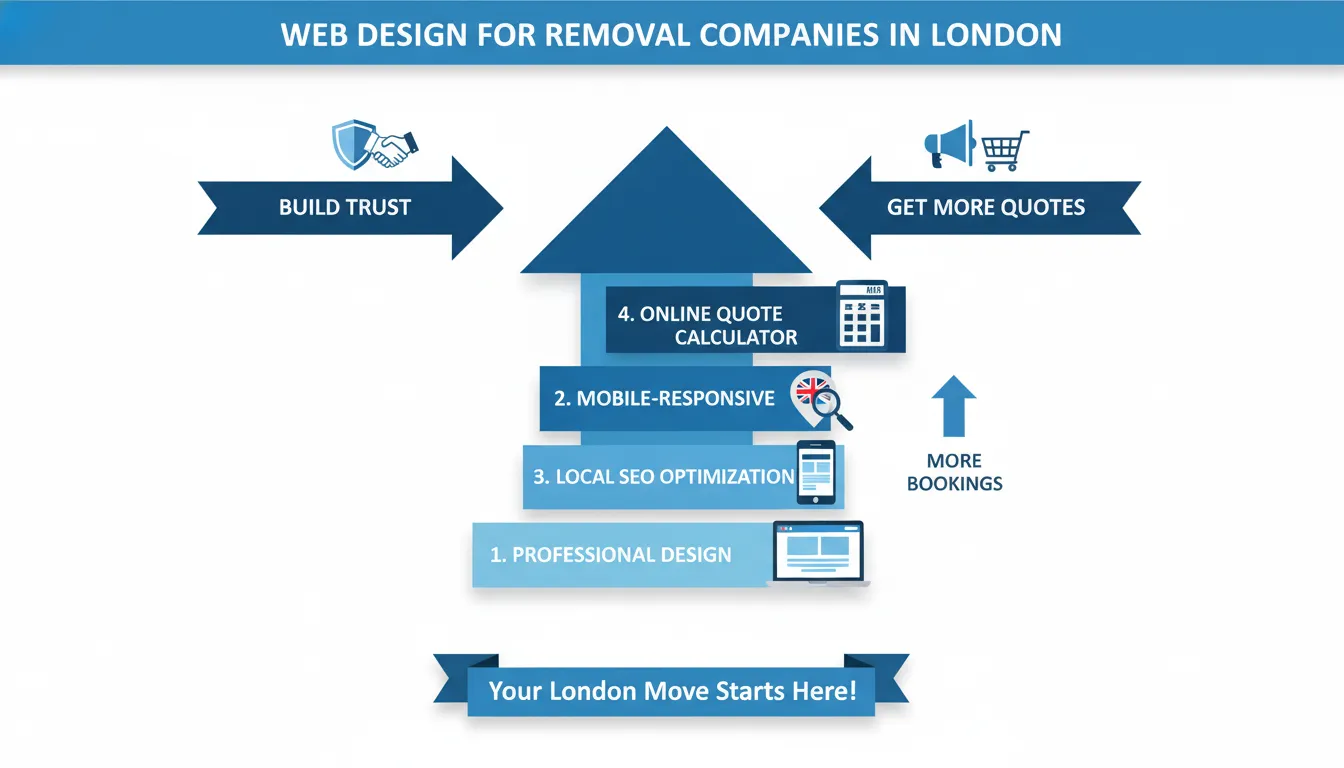
Key Takeaways
The good news? We’ve worked with over 200 London removal companies, man and van services, and moving businesses. We know exactly what works. We know which trust signals actually convert browsers into paying customers. We know how to design a removal company website that doesn’t just look good—it generates real, qualified inquiries.

This guide breaks down everything you need to know about professional web design for removal companies in London. From the specific trust signals that matter most, to the exact elements your site needs to generate more quotes, to the common mistakes that are costing you business right now.
What Professional Web Design for Removal Companies Actually Means
When we talk about “web design for removal companies,” we’re not talking about pretty graphics and fancy animations. We’re talking about a strategic, conversion-focused website built specifically for how removal customers think and buy.
A removal company website serves one primary purpose: generating qualified quote inquiries from local customers who are ready to move. Everything else—testimonials, service descriptions, photos—supports that single goal.
Here’s what separates a professional removal company website from an amateur one:
Strategic Focus: A professional site understands that removal customers are under time pressure. They’re moving in 2-3 weeks, and they need quotes fast. Every element is designed to help them get information quickly and submit an inquiry just as quickly.
Trust-First Design: Moving companies handle people’s most treasured possessions. A professional website acknowledges this anxiety and addresses it head-on with trust signals: insurance information, verifications, testimonials from real customers, proof of experience.
Local Relevance: For London removal companies, this means showcasing your knowledge of London neighborhoods, London logistics, London pricing. A generic “we move anything, anywhere” website doesn’t work. Londoners want to know you understand their city.
Mobile-First Structure: Over 60% of people searching for removal companies are using mobile phones. A professional site isn’t “also available on mobile”—it’s designed for mobile first, then adapted for desktop.
Conversion Optimization: Every page, every image, every form field is tested and optimized to turn browsers into inquiries. That means removing friction, making forms simple, and making it obvious what you want visitors to do next.
Most removal company websites miss 3-5 of these elements. They wonder why they’re not getting inquiries. They assume they need to pay more for advertising. In reality, they just need a website that actually works.
The 6 Critical Trust Signals Every Removal Company Website Needs
Trust is the currency of the removal industry. When someone is considering hiring your company to move their home, they’re making a decision based largely on whether they trust you with their belongings and their move.
Generic promises don’t create trust. Proof creates trust. Here are the six trust signals that actually move the needle:
1. Verified Customer Testimonials and Reviews
This isn’t optional. 92% of people trust reviews and recommendations from other customers more than they trust advertising. For removal companies, this is especially true.
The mistake most removal companies make is either having no testimonials, or having vague testimonials like “Great service!” A professional website has:
– Video testimonials from real customers talking about their move
– Detailed written testimonials that mention specific scenarios (they moved a piano, they moved within tight London traffic, they handled a difficult access situation)
– Star ratings and verified review badges from Google, Trustpilot, or similar platforms
– Photos of the customer alongside their testimonial (with permission)
Why this works: When someone is anxious about hiring a removal company, seeing another person who faced the same anxiety and had a great experience instantly reduces that fear. A video testimonial—even 30 seconds of someone saying “These guys moved my entire house and I didn’t worry once”—is worth more than a paragraph of marketing copy.
A professional removal company website should have at least 15-20 detailed testimonials visible across the site, with at least 3-4 video testimonials embedded where prospects can watch them.
2. Insurance, Licensing, and Certifications—Clearly Displayed
Most London removal companies have proper insurance and licensing. Almost none display it prominently on their website.
This is leaving money on the table.
When someone is deciding between your company and a competitor, one of their biggest questions is: “What happens if something breaks?” Showing that you’re fully insured, bonded, and certified answers that question immediately and removes a major barrier to hiring you.
A professional website displays:
– Insurance badges from recognized providers (British Association of Removers, FIDI, or your specific insurance company)
– Licensing information clearly stated (operating in London under license number, etc.)
– Certifications (Health & Safety, COVID protocols, accessibility standards, etc.)
– What’s covered in your insurance (a simple infographic showing “We cover: furniture damage, theft, breakage, etc.”)
This doesn’t require redesigning your site. It requires adding these elements prominently. On your homepage. In your footer. On your “About Us” page. Repeated, so prospects see it multiple times.
3. Before & After Gallery and Real Project Photos
A removal company website without photos of actual moves is missing a massive trust-building opportunity.
Before and after photos of actual moves do two things:
1. They prove you do what you say you do. They show real work, real customers, real results.
2. They help customers visualize their own move. When a customer sees a photo of someone’s 3-bedroom house being packed and loaded, they can imagine their own 3-bedroom house being handled the same way.
A professional removal company website should have:
– Minimum 30-40 high-quality photos of actual moves
– Before and after shots of specific jobs (house packed, house loaded, house being moved, house unpacked)
– Photos organized by service type (house moves, office moves, piano moves, etc.)
– Tags showing the area of London where the move took place
– Customer permission slips for all photos (important for legal reasons)
These photos don’t need to be professionally shot (though that helps). They need to be real. A photo taken on a moving day—even with a smartphone—is more trustworthy than a stock photo of generic removal workers.
4. Detailed Service Descriptions Specific to London
Generic service descriptions don’t build trust. Detailed, specific descriptions do.
Instead of “House Removals,” your website should have:
– “House Removals in London: From Studio Flats to Period Homes” with specific information about how you handle Victorian conversions, narrow London staircases, flat moves with no street parking, etc.
– “Office Moves in Central London” with information about your experience with building access restrictions, working during office hours, etc.
– “Moving Within London’s Congestion Charge Zone” with information about how you navigate it
Why this works: When someone searching for “removal company near me” lands on your site, they need to know you understand their specific situation. A person moving a Victorian townhouse in Notting Hill needs to know you’ve moved Victorian townhouses. A business moving from one London office to another needs to know you understand London’s office building access restrictions.
Detailed service descriptions also help with search visibility. When you describe specific scenarios (moving within zone 1, moving period properties, moving from conversions), you’re naturally including the keywords people are actually searching for.
5. Clear Pricing and Transparent Cost Breakdown
Price opacity kills trust.
Most removal company websites are vague about pricing. “Get a quote” is the only pricing information available. This is a mistake. Prospects want to know roughly what something costs before requesting a quote—not to lock in a price, but to know if you’re even in their ballpark.
A professional website provides:
– Pricing ranges for common move types (“House move within London: £800-£2,500 depending on size”)
– What’s included in each price (packing materials, labor, van hire, etc.)
– What costs extra (parking permits, stairlifts, specialist items)
– A pricing calculator where customers can input their move details and get an instant estimate
– Transparent information about how you price moves (by van size, by hours, by distance, etc.)
This doesn’t mean you’re locked into a specific price for every job. It means you’re being transparent about your pricing structure. Transparency builds trust. Vagueness doesn’t.
6. Quick Response Time Guarantee
People shopping for removal quotes are under time pressure. They need a quote fast. They need to know you’re responsive.
A professional website includes:
– “We respond to quote requests within 2 hours” (or whatever your actual commitment is)
– Phone numbers prominently displayed and answered during business hours
– Live chat or WhatsApp chat option for quick questions
– Multiple contact methods (phone, email, chat, contact form) so customers can reach you however is fastest for them
This signal doesn’t require any special technology. It just requires you to make a commitment and keep it.
How to Structure Your Removal Company Website for Maximum Quote Generation
Website structure matters more than most business owners realize. The way you organize your pages, the flow you create, and the journey you guide prospects on—all of this dramatically impacts your conversion rate.
Here’s how a professional removal company website should be structured:
Homepage: Your Digital Front Door
Your homepage has one job: help the visitor understand what you do and get them to request a quote.
A professional removal company homepage includes:
Above the fold (what they see without scrolling):
– A clear headline: “Professional House Removals Across London” (or your specific service)
– A single, prominent call-to-action button: “Get a Free Quote”
– A customer testimonial or social proof (e.g., “Trusted by 200+ London families”)
– A professional hero image showing a removal in progress or a satisfied customer
As they scroll:
– Your main service areas (showing specific London neighborhoods or postcodes)
– What’s included in your service (packing, loading, transport, unloading, unpacking)
– Customer testimonials (3-4 detailed ones, ideally with photos)
– Before and after photos from real moves
– Insurance and certification badges
– Pricing information or pricing calculator
– FAQ section addressing common concerns
– Another call-to-action: “Ready to Move? Get Your Free Quote”
At the bottom:
– Contact information (phone, email, address)
– Trust signals (years in business, number of moves completed, customer satisfaction rating)
– Links to service pages and other important pages
– Final call-to-action
The structure is intentional. You’re giving prospects multiple opportunities to request a quote as they learn more about you. You’re building trust as they scroll. You’re answering objections before they arise.
Service Pages: Detailed Information for Specific Moves
Each service should have its own page. Not because you’re trying to game search engines, but because different moves have different concerns.
A professional “House Removals” page includes:
– A clear description of what’s included in a house move
– How your process works (step-by-step: consultation, packing, loading, transport, unloading, unpacking)
– Photos and videos of house moves
– Testimonials specifically from people who moved houses (not office moves or piano moves)
– Pricing information for house moves
– FAQs specific to house moves (What if my house is very cluttered? What happens if something is damaged? etc.)
– Service options (full service, self-pack, etc.)
– A call-to-action button: “Get Your House Move Quote”
The same structure applies to other services (office moves, piano moves, etc.). Each service page is thorough enough that someone visiting it gets all the information they need, without being overwhelmed.
About Page: Building Personal Connection and Credibility
People buy from people. An “About Us” page humanizes your business and builds credibility.
A professional removal company About page includes:
– Your story: How you started, why you started, what you’re passionate about
– Team photos: Real photos of your actual team members (with names and brief bios)
– Your experience: Years in business, number of moves, recognitions, and awards
– Your values: What you care about (customer service, reliability, environmental responsibility, etc.)
– Insurance and certifications: Displayed prominently
– Community involvement: Any work you do in the local London community
– Customer service guarantees: What you promise to customers
This page doesn’t need to be long. It needs to be personal and credible. It needs to make the visitor feel like they’re hiring people, not a faceless company.
Contact and Quote Pages: Removing Friction
Your quote request form is where browsers convert to leads. It’s critical.
A professional quote form:
– Is short: Maximum 5-7 fields (name, phone, email, move date, current postcode, destination postcode, brief description)
– Is mobile-optimized: Easy to fill out on a phone
– Explains what happens next: “We’ll call you within 2 hours with an estimate”
– Has clear next steps: After submitting, they see a confirmation with when they’ll hear from you
– Offers alternatives: They can also call directly, use live chat, or email
The biggest mistake removal companies make is complicated quote forms with 15+ fields. Every field you add reduces completion rates. Keep it simple.
Tools, Technology, and Cost Breakdown for Professional Removal Company Web Design
Not all removal companies need the same website complexity. Your needs depend on your business size, your quote volume, and your growth stage.
Here’s what you’re actually paying for:
Core Website Elements: £2,000-£5,000
This covers the essential website build:
– Domain registration: £10-£15/year
– Website hosting: £100-£300/year (or £800-£3,000 for premium managed hosting)
– Professional website design: £2,000-£5,000 (can be done once by an agency, or built on a WordPress or template platform for lower cost)
– SSL certificate (security): Usually included with hosting
– Basic SEO optimization: Included in professional design
Essential Features and Integrations: £1,000-£3,000
These are the features that actually generate quotes:
| Feature | Cost | Why It Matters |
| ——— | —— | —————- | <br /> |
|---|---|---|---|
| Quote request form builder | £0-£200 | Allows customers to request quotes online | |
| Email automation | £0-£100/month | Sends quote requests to your team automatically | |
| Google Business Profile setup | £0 | Critical for local search visibility | |
| Google Reviews integration | £0 | Shows customer reviews on your site | |
| Google Maps integration | £0 | Shows your service area | |
| Blog platform (for content) | Included | Helps with SEO and customer education | |
| Mobile optimization | Included in design | Essential for conversion | |
| Website analytics (Google Analytics) | £0 |