In the highly regulated security industry, your website isn’t just a marketing tool—it’s a statement of professionalism, credibility, and compliance. Yet many London security companies are still operating with outdated websites that fail to instil trust, communicate expertise, or comply with industry standards. According to recent data, 87% of potential security clients research companies online before making enquiries, and 62% are more likely to hire firms with professional, modern websites. This is a problem because a poorly designed security website can cost you contracts, damage your reputation, and expose you to compliance risks.
The security industry in London is fiercely competitive. Whether you’re a SIA-licensed security guard company, manned guarding service, event security provider, or corporate security firm, your digital presence directly impacts your ability to win contracts. Clients want to see credentials, insurance, training certifications, team experience, and clear service descriptions. They want to feel confident that they’re hiring professionals who understand their industry. A generic website template won’t cut it.
This is where specialist security company web design comes in. We’ve designed professional, SIA-compliant websites for 200+ London businesses across the security sector. We understand the unique challenges facing security firms: stringent compliance requirements, the need to build trust quickly, the importance of showcasing credentials, and the pressure to stand out in a crowded market. Our approach combines stunning visual design, conversion-focused copywriting, mobile responsiveness, and built-in compliance features—all tailored specifically to the security industry.
In this comprehensive guide, we’ll walk you through everything you need to know about web design for security companies in London. You’ll discover what makes a security website effective, the key features you need to include, compliance considerations, cost expectations, and real-world examples of security websites that actually convert leads into contracts.
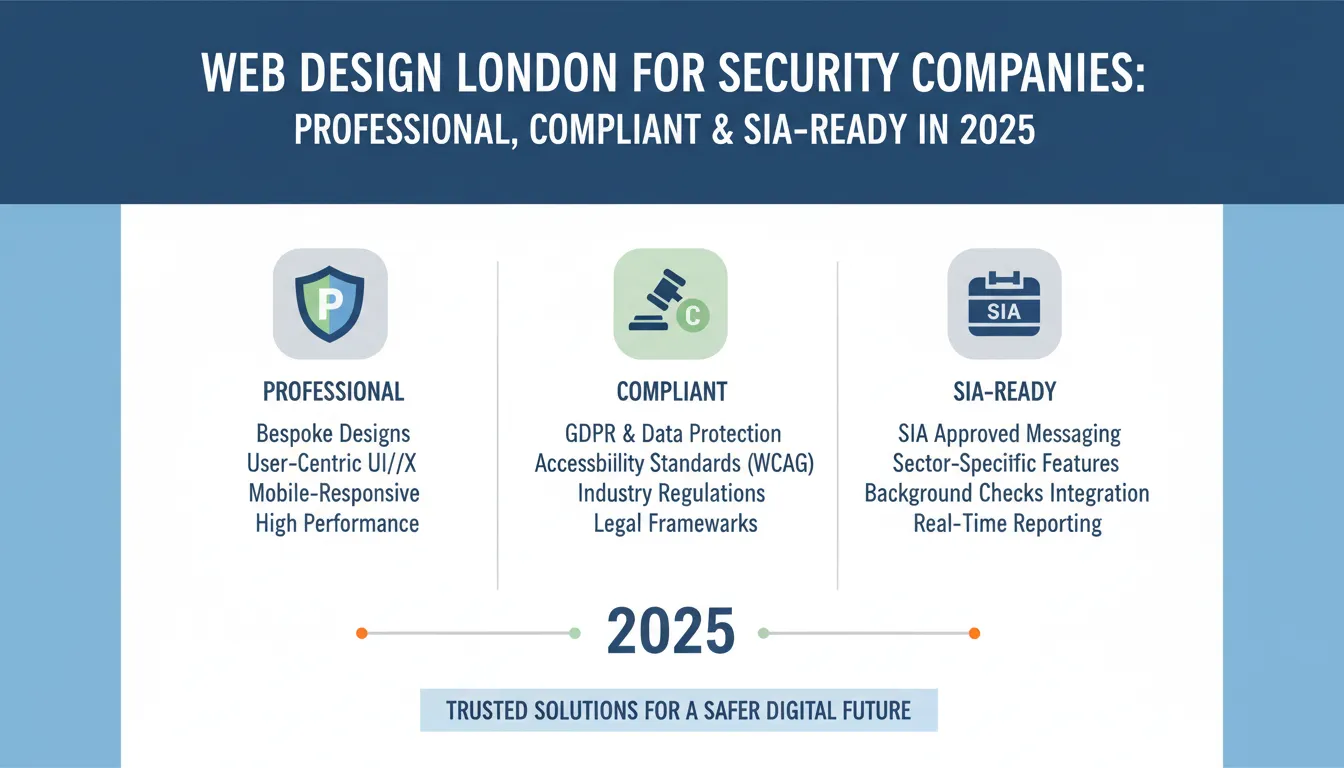
Key Takeaways
What Is Professional Security Company Web Design?
Professional security company web design is a specialist service tailored to the unique needs of the security industry. It’s not just about building a pretty website—it’s about creating a digital asset that works harder to win contracts, establish trust, communicate your credentials, and ensure compliance with industry standards.
A security company website serves multiple critical functions. First, it acts as a credibility machine. Potential clients—whether corporate companies, event venues, property managers, or government organisations—need to verify that you’re legitimate, licensed, and professional. Your website is often their first impression. Second, it’s a lead generation tool. Security companies operate on contract-based business models, so your website needs to capture enquiries from decision-makers actively searching for security solutions. Third, it’s a trust-builder. The security industry is built on trust. Your website needs to communicate that you employ trained, vetted professionals who understand their responsibilities.
Security company web design differs from generic business web design in several critical ways:
Compliance Focus: Security websites must reflect SIA (Security Industry Authority) requirements, data protection regulations (GDPR), and industry best practices. This includes clear policy pages, data handling statements, and professional standards documentation.
Credential Showcase: Your website must prominently display SIA licenses, security clearances, insurance certificates, training qualifications, and team credentials. This builds immediate trust.
Trust Signals: Security clients need assurance. This means client testimonials, case studies, response time guarantees, and detailed service descriptions that demonstrate expertise.
Lead Capture Optimization: Security services typically involve detailed enquiries. Your website needs forms, contact systems, and information architecture designed to capture complex requirements from serious prospects.
Mobile Optimization: Many security decision-makers research on mobile devices while on-site or between meetings. Your website must perform flawlessly on all devices.
Service Clarity: Security services can be complex. Your website must clearly explain what you offer, who you serve, and how you differ from competitors.
Professional security company web design addresses all of these needs within a cohesive, visually impressive platform that reflects the professionalism of your team.
Key Features Every Security Company Website Needs
To convert visitors into enquiries, your security company website must include specific features that speak directly to client concerns and demonstrate your expertise. These aren’t optional extras—they’re essential components that determine whether your website succeeds or fails.
Clear Service Descriptions and Pricing: Your website must spell out exactly what you offer. Don’t assume visitors understand the difference between manned guarding, event security, close protection, and corporate security. Create dedicated pages for each service with detailed descriptions, typical use cases, and response time guarantees. If you offer pricing tiers, display them transparently. If prices are bespoke (common in security), explain your quotation process clearly. Ambiguity loses enquiries.
Prominent Credential Display: This is non-negotiable. Feature your SIA license prominently—ideally in a dedicated section or as a badge on your homepage. Include certifications for team members (Level 1, Level 2, Level 3 SIA certifications), insurance documents, accreditations, and any industry partnerships. Use visual badges and trust indicators. This immediately answers the question every prospect asks: “Are you legitimate?”
Client Testimonials and Case Studies: Security is an industry where word-of-mouth and proof of past work matter enormously. Feature 5-10 strong testimonials from recognizable clients (with permission). Include at minimum: client name/company, their testimonial quote, their role, and ideally a headshot. Case studies should detail the problem you solved, your approach, and the measurable outcomes (faster response times, zero incidents, cost savings, etc.).
Team Profiles and Experience: Potential clients want to know who they’re hiring. Create a team page featuring your senior team, their experience, certifications, and backgrounds. Include professional headshots. This humanizes your business and demonstrates that you employ skilled professionals.
Emergency Response and Availability: Many security clients need 24/7 availability. Make this crystal clear. Include response time guarantees, emergency contact procedures, and availability information. This reassures clients that you’re dependable.
Insurance and Compliance Information: Create a dedicated compliance page listing your insurance coverage (public liability, professional indemnity, etc.), your GDPR data policy, and your commitment to industry standards. Link to any relevant documents.
Contact and Quotation System: Make enquiring effortless. Include multiple contact options (phone, email, contact form), a detailed quotation request form that captures project requirements, and information about your response time. Many security contracts are complex—your quotation form should reflect this.
Client Testimonial Sections: Security is trust-based. Feature testimonials prominently on your homepage and service pages. Include company logos of major clients (with permission) to build credibility.
Mobile Responsiveness: At least 50% of your traffic comes from mobile devices. Your website must load fast and display beautifully on all screen sizes.
Professional Imagery: Use high-quality photography of your team, equipment, and client sites (respecting confidentiality). Stock photos of random security personnel damage credibility.
These features work together to create a website that doesn’t just look professional—it actively builds trust and captures serious enquiries.
Step-by-Step Guide: Building Your Security Company Website
Building an effective security company website involves a structured process that ensures every element serves your business goals. Here’s how we approach it with our London security clients:
Step 1: Discovery and Strategy
Before design begins, we spend time understanding your business deeply. This includes:
– Your target market (corporate clients, events, property management, government, etc.)
– Your specific services (manned guarding, close protection, event security, mobile patrols, CCTV monitoring, etc.)
– Your competitive positioning (what makes you different?)
– Your current lead sources and conversion rates
– Your SIA licenses and certifications
– Your team’s experience and credentials
– Your typical contract value and sales cycle
This discovery phase is crucial. Many security companies make the mistake of rushing into design without this foundational thinking. The result? A beautiful website that doesn’t actually convert prospects into clients.
During discovery, we also conduct competitive research. We analyse 5-10 competing London security companies—examining their websites, service positioning, messaging, and apparent conversion strategies. This helps us identify opportunities to differentiate you.
Step 2: Information Architecture and Messaging
Next, we map out your website structure and develop clear messaging for each page. For a typical security company, the structure might look like:
– Homepage: Brand story, key services, credentials, testimonial, CTA
– Services Pages (e.g., Manned Guarding, Event Security, Close Protection): Detailed service description, typical use cases, team experience, pricing/quotation process
– About Us: Company story, mission, team profiles, experience, certifications
– Why Choose Us/Differentiators: What sets you apart—team experience, response times, technology, customer service, etc.
– Testimonials/Case Studies: Detailed case studies and client reviews
– Compliance/Security: Data policy, insurance information, SIA documentation, industry certifications
– Contact/Quotation: Multiple contact options, quotation request form, emergency contact info
– Blog (Optional but recommended): Industry insights, security tips, thought leadership
For each page, we develop clear messaging that speaks to your target client’s concerns. The goal is to answer their unspoken questions: Are you legitimate? Do you have experience with my industry? Can you handle my specific requirements? What will this cost? How quickly can you respond?
Step 3: Design and Branding
With strategy in place, design begins. For security companies, we typically recommend:
– Professional colour palette: Blues, dark greys, and blacks convey trust and professionalism. We balance this with accent colours for CTAs and key elements.
– Clean, modern layout: Avoid cluttered designs. Security clients appreciate clarity and sophistication.
– Professional typography: Use readable, modern fonts that convey professionalism.
– High-quality imagery: Professional photographs of your team and (with client permission) your work. We avoid stock photos of random security staff unless necessary.
– Trust badges and credentials: Display SIA license, insurance badges, industry certifications prominently.
– Mobile-first design: We design for mobile devices first, then scale up. This ensures the mobile experience is excellent.
Design also includes user experience (UX) optimization. Every page should have a clear purpose and a primary call-to-action (usually “Request a Quote” or “Contact Us”). Forms should be streamlined to ask only essential questions. Navigation should be intuitive.
Step 4: Development and Integration
Once design is approved, we move to development. This includes:
– Responsive coding: Building the website to display perfectly on all devices and browsers.
– CMS implementation: We typically use WordPress for security company websites (though we also use custom platforms). WordPress offers flexibility, security, and ease of updating.
– Form integration: Setting up contact forms, quotation request forms, and email automation. When someone submits a form, you need instant notification.
– SEO foundation: Implementing technical SEO (fast load times, clean code, proper header tags, metadata, XML sitemaps).
– Security features: SSL certificates, secure contact forms, GDPR-compliant data handling.
– Analytics integration: Installing Google Analytics and conversion tracking to measure performance.
Step 5: Content Creation and Optimization
Website design is only 30% of the equation. The other 70% is content. We typically create or refine:
– Homepage copy: A compelling narrative that immediately communicates who you are and what you do.
– Service page copy: Detailed descriptions of each service, typical use cases, team experience, and CTAs.
– Testimonials and case studies: We often work with you to gather and format these. Ideally, each case study should be 300-500 words and include the problem, solution, and measurable results.
– About page copy: Your company story, mission, team experience, and differentiators.
– Blog posts (optional): Thought leadership content that helps prospects understand security considerations relevant to their industry.
Content must be clear, benefit-focused, and optimized for the keywords security prospects actually search for (e.g., “event security London,” “manned guarding services,” “close protection services”).
Step 6: Compliance Review and Optimization
Before launch, we conduct a compliance review:
– Data Protection: Is your privacy policy clear and GDPR-compliant?
– Accessibility: Does the website meet WCAG accessibility standards?
– Industry Standards: Does the site reflect professional standards for the security industry?
– SIA Compliance: Are credentials displayed appropriately?
– Performance: Does the site load quickly on all devices?
We then launch the website and monitor its performance closely for the first 30 days, making adjustments as needed.
Step 7: Ongoing Optimization
After launch, a professional security website requires ongoing optimization:
– Monitoring lead quality: Are you capturing the right prospects?
– Form optimization: Can you simplify forms further to increase submission rates?
– Content updates: Refreshing testimonials, case studies, and team information quarterly.
– SEO refinement: Building backlinks, optimizing for local search, publishing content that ranks.
– Conversion rate testing: A/B testing headlines, CTAs, and page layouts to improve conversion rates.
A website isn’t a one-time investment. It’s an ongoing asset that requires attention to keep performing.
Essential Compliance and SIA Requirements
The security industry operates within strict regulatory frameworks. Your website must reflect this professionalism and compliance. Here’s what you need to know:
SIA License Display: Your SIA license number should be prominently displayed. The SIA’s official guidance recommends featuring your license on your website, along with your license status (active, expired, etc.). We recommend a dedicated badge on your homepage and a detailed credentials page.
Data Protection and GDPR: When you collect prospect information through forms (names, company details, contact information), you’re processing personal data. You must have a clear privacy policy explaining what you do with this data, how long you retain it, and the rights individuals have. We ensure all websites include GDPR-compliant privacy policies and consent mechanisms.
Professional Standards: The security industry has professional standards around qualifications, training, and conduct. Your website should communicate that you adhere to these standards. This might include referencing:
– SIA Level 1, 2, and 3 certifications for relevant team members
– DBS clearance processes for your team
– Training compliance (first aid, conflict management, etc.)
– Industry body membership (e.g., BSIA if applicable)
Insurance and Liability: Display your insurance coverage clearly. Clients need confidence that you carry appropriate public liability and professional indemnity insurance. Some industries (like event security) require specific coverage levels. Your website should reference this.
Accurate Service Descriptions: Avoid overstating capabilities. If you’re not licensed for a specific type of work, don’t claim to offer it. Inaccurate claims damage credibility and create legal risk.
Client Confidentiality: When featuring case studies or testimonials, ensure you have written permission and don’t disclose confidential information. Some client sites have security requirements that restrict public reference.
Terms and Conditions: Your website should include clear terms of engagement, cancellation policies, and any relevant disclaimers. These protect both you and your clients.
Professional security company websites earn trust partly through transparency around these compliance matters. When prospects see that you take compliance seriously, it builds confidence.
Tools, Platforms, and Cost Breakdown for Security Website Design
There are multiple approaches to building a security company website. Let’s break down the options, tools, and realistic costs:
Platform Options
WordPress (Our Recommendation for Most Security Companies